Border campaign (Irish Republican Army)
Videos
Photos
The border campaign was a guerrilla warfare campaign carried out by the Irish Republican Army (IRA) against targets in Northern Ireland, with the aim of overthrowing British rule there and creating a united Ireland. It was also referred to as the "resistance campaign" by some Irish republican activists. The campaign was a military failure, but for some of its members was justified as it kept the IRA engaged for another generation.

Commemorative plaque to the Edentubber Martyrs, killed in November 1957
Irish Republican Army (1922–1969)
Videos
Photos
The Irish Republican Army (IRA) of 1922–1969, an anti-Treaty sub-group of the original Irish Republican Army (1919–1922), fought against the British-backed Irish Free State in the Irish Civil War, and its successors up to 1969, when the IRA split again into the Provisional IRA and Official IRA. The original Irish Republican Army fought a guerrilla war against British rule in Ireland in the Irish War of Independence between 1919 and 1921. Following the signing of the Anglo-Irish Treaty on 6 December 1921, the IRA in the 26 counties that were to become the Irish Free State split between supporters and opponents of the Treaty. The anti-Treatyites, sometimes referred to by Free State forces as "Irregulars",A continued to use the name "Irish Republican Army" (IRA) or in Irish Óglaigh na hÉireann, as did the organisation in Northern Ireland which originally supported the pro-Treaty side. Óglaigh na hÉireann was also adopted as the name of the pro-Treaty National Army, and remains the official legal title of the Irish Defence Forces.

An Anti-Treaty IRA unit in Old Parish, County Waterford, c. 1922.

Liam Lynch was the first Chief of Staff of the Anti-Treaty IRA. He died during the Irish Civil War.
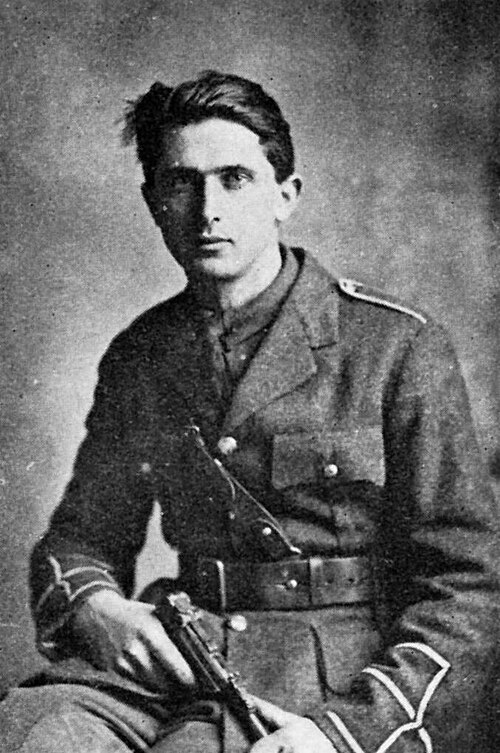
Mick Mansfield, Staff Engineer, Waterford Brigade, 1922.

Memorial to anti-Treaty insurgents executed by Free State forces at Ballyseedy, County Kerry, designed by Yann Goulet.