Borealis Basin
Videos
The North Polar Basin, more commonly known as the Borealis Basin, is a large basin in the northern hemisphere of Mars that covers 40% of the planet. Some scientists have postulated that the basin form

The moons of Mars, Phobos and Deimos. Phobos is the larger of the two moons, and is the closer of the two to Mars. Phobos has an average radius of 11 km, while Deimos has an average radius of 6 km.

Lomonosov crater, the most likely candidate for the impact that produced the tsunami. It is 150 km in diameter, and is a prominent feature of the Borealis basin.
Mars
Videos
Mars is the fourth planet from the Sun. It is also known as the "Red Planet", for its orange-red appearance. Mars is a desert-like rocky planet with a tenuous atmosphere that is primarily carbon dioxi
Borealis Basin
…The North Polar Basin, more commonly known as the Borealis Basin, is a large basin in the northern hemisphere of Mars that covers 40% of the planet. Some scientists have postulated that the basin formed during the impact of a single, large body roughly 2% of the mass…
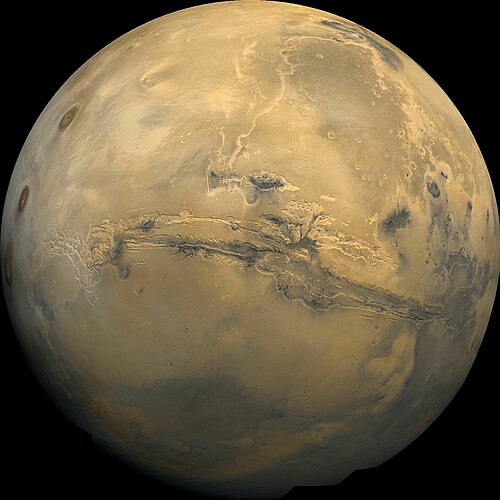
Valles Marineris, taken by the Viking 1 probe

Artist concept showing sand-laden jets erupting from Martian geysers (published by NASA; artist: Ron Miller)

A 30 meter wide and 800 meter high dust devil. Dust devils of 20 kilometer height have been observed.
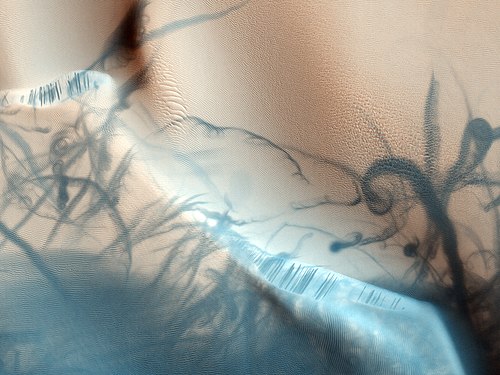
Dust devils cause twisting dark trails on the Martian surface