Mars
Videos
Mars is the fourth planet from the Sun. It is also known as the "Red Planet", for its orange-red appearance. Mars is a desert-like rocky planet with a tenuous atmosphere that is primarily carbon dioxi
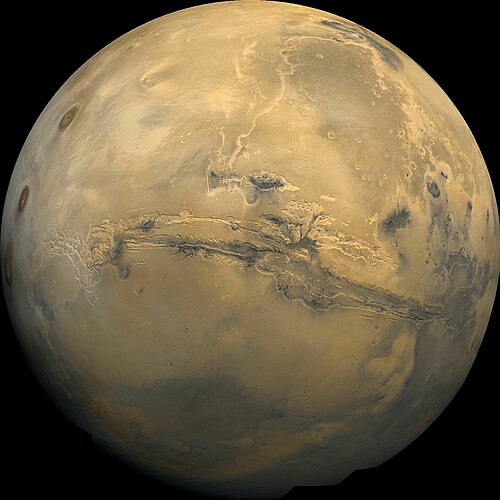
Valles Marineris, taken by the Viking 1 probe

Artist concept showing sand-laden jets erupting from Martian geysers (published by NASA; artist: Ron Miller)

A 30 meter wide and 800 meter high dust devil. Dust devils of 20 kilometer height have been observed.
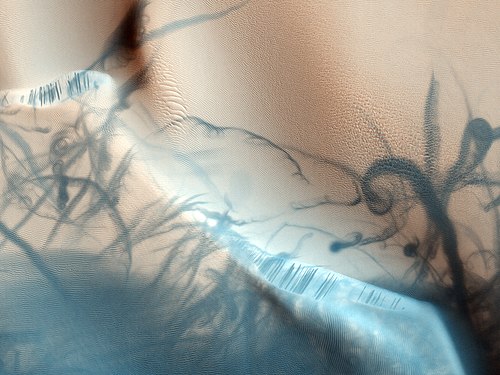
Dust devils cause twisting dark trails on the Martian surface
Phobos (moon)
Videos
Phobos is the innermost and larger of the two natural satellites of Mars, the other being Deimos. The two moons were discovered in 1877 by American astronomer Asaph Hall. Phobos is named after the Gre
Mars
…largest canyons in the Solar System (Valles Marineris, 4,000 km or 2,500 mi long). Mars has two natural satellites that are small and irregular in shape: Phobos and Deimos. With a significant axial tilt of 25 degrees, Mars experiences seasons, like Earth (which has an axial tilt of 23.5 degrees). A Martian solar…

A false color composite image of Phobos captured by the Mars Reconnaissance Orbiter in 2008

Deimos and Phobos as seen from Mars, compared in apparent size to the Moon as seen from Earth

An artist's concept of Martian Moons eXploration spacecraft

The Phobos monolith (right of center) as taken by the Mars Global Surveyor (MOC Image 55103, 1998)