British Indian Army
Videos
The Indian Army during British rule, also referred to as the British Indian Army, was the main military force of India until national independence in 1947. Formed in 1895 by uniting the three Presiden

c. 1835 painting of the 40th Regiment of Madras Native Infantry

c. 1908 illustration of the Corps of Guides

No. 2 Company of the Bombay Sappers and Miners during the Boxer Rebellion, China, 1900.

Indian Army soldiers, including men from the 3rd Sikh regiment and 1st Sikh Infantry, Punjab Frontier Force, in Beijing, c. 1900.
Indian Army
Videos
The Indian Army is the land-based branch and largest component of the Indian Armed Forces. The President of India is the Supreme Commander of the Indian Army, and its professional head is the Chief of
British Indian Army
…service, but were eventually moved back to India. The partition reduced the ethnic imbalance of the British Indian Army, which became the present-day Indian Army. But, the partition resulted in more ethnic imbalance in the Pakistani military, mainly because the new nation state of Pakistan was formed by joining…

No. 4 (Hazara) Mountain Battery with RML7 pounder "Steel Gun" Mountain Gun in Review Order. Left to right Naick, Havaldar, Subadar (Sikhs) and Gunner (Punjabi Musalman) c. 1895.

Indian Cavalry on the Western Front during World War I.

A Sikh soldier of the 4th Division (the Red Eagles) of the Indian Army, attached to the British Fifth Army in Italy. Holding a captured Nazi flag after the surrender of German forces in Italy, May 1945. Behind him, a fascist inscription says "VIVA IL DUCE", "Long live the Duce" (i.e. Mussolini).
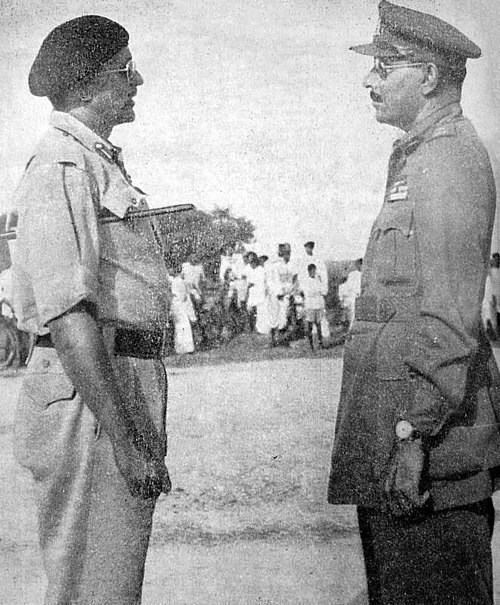
Major General El Edroos (at right) offers his surrender of the Hyderabad State Forces to Major General (later Army Chief) J.N. Chaudhuri at Secunderabad