British Raj
Videos
The British Raj was the period of rule of the British Crown on the Indian subcontinent, lasting from 1858 to 1947. It is also called Crown rule in India, or direct rule in India. The region under Brit
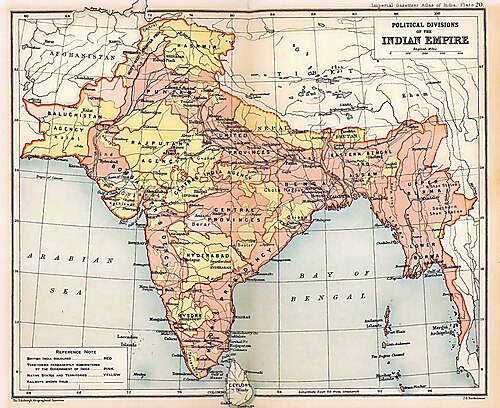
Political subdivisions of the British Raj in 1909. British India is shown in two shades of pink; Sikkim, Nepal, Bhutan, and the princely states are shown in yellow.

The British Raj and surrounding countries are shown in 1909

The British Raj in relation to the British Empire in 1909

Lakshmibai, Rani of Jhansi, one of the principal leaders of the Great Uprising of 1857, who had lost her kingdom by the Doctrine of lapse
Company rule in India
Videos
Company rule in India was the rule of the British East India Company on the Indian subcontinent. This is variously taken to have commenced in 1757, after the Battle of Plassey, when the Nawab of Benga
British Raj
…Olympics in 1900, 1920, 1928, 1932, and 1936. This system of governance was instituted on 28 June 1858, when, after the Indian Rebellion of 1857, the rule of the East India Company was transferred to the Crown in the person of Queen Victoria (who, in 1876, was proclaimed Empress of India). It lasted until…

Regions under Company rule shown in two shades of pink (a) very light (1774–1804) and (b) medium (1805–1858)

India in 1765 and 1805 showing East India Company Territories in pink.

India in 1837 and 1857, showing East India Company-governed territories in pink.

Silver Half-Rupee 1787 Bengal Presidency, Murshidabad Mint, issued in the name of Shah Alam II, Mughal Emperor