British expedition to Tibet
Videos
The British expedition to Tibet, also known as the Younghusband expedition, began in December 1903 and lasted until September 1904. The expedition was effectively a temporary invasion by British India

British Raj officers with Qing amban and Tibetans

Lamellar coat and helmet. From Tibet, in modern-day China. 14th–17th century CE. Iron, leather, and textile. Presented by Lieutenant Colonel Sir Francis Younghusband. Discoveries Gallery, National Museum of Scotland

Major Francis Younghusband leading a British force to Lhasa in 1904

Tibetan soldier during target practice
Tibet under Qing rule
Videos
The Qing dynasty, led by the Manchus, ruled Tibet from 1720 to 1912. The Qing called Tibet a fanbu, fanbang or fanshu, which has usually been translated as "vassal", "vassal state", or "borderlands",
British expedition to Tibet
…of the British Indian Empire. Tibet was ruled by the 13th Dalai Lama under the Ganden Phodrang government as a Himalayan state nominally under the protectorate (or suzerainty) of the Chinese Qing dynasty until the 1911 Revolution, after which a period of de facto Tibetan independence (1912–1951) followed. The…
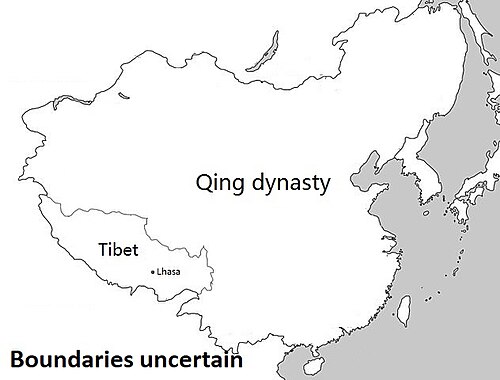
Qing dynasty and Tibet

Lhazang Khan

Lungtok Gyatso, 9th Dalai Lama, with lamas and monks, and ambans inattendance, around 1808.

Lhasa Amban's yamen from Southeast around 1900–1901.