Bwa people
Videos
The Bwa is an African society that is native to Burkina Faso. This society has an approximate population of over 300,000 persons. The Bwa people live in a number of individualized communities. They ha
Luruya mask with abstract design of geometric patterns, all of which are symbolic; 19th-20th centuries; painted wood and fibre; height: 81.3 cm; Birmingham Museum of Art (USA). This diminutive mask represents Luruya, an ancestor who was small in stature yet revered because he could communicate with animals. The crescent above the a panel with crossed lines, and a red horn above a circular face are characteristic of Bwa plank masks. The lines represent forehead scarification

Animism
Videos
Animism is the worldview or perception that various types of natural phenomena, including non-human organisms and often even landforms and inanimate objects, possess distinct spiritual essences, souls
Bwa people
…Soxo, the god of the wilderness, and Kwere, the lightning god. Two and his significance is heavily depicted in the Boni Bwa's ceremonial leaf masks. Animism is the main religious belief practiced by the Bwa. In fact, the art work that the Bwa are known for is primarily used for animist practices—specifically…

Edward Tylor developed animism as an anthropological theory.

Five Ojibwe chiefs in the 19th century. It was anthropological studies of Ojibwe religion that resulted in the development of the "new animism".

Animist altar, Bozo village, Mopti, Bandiagara, Mali, in 1972
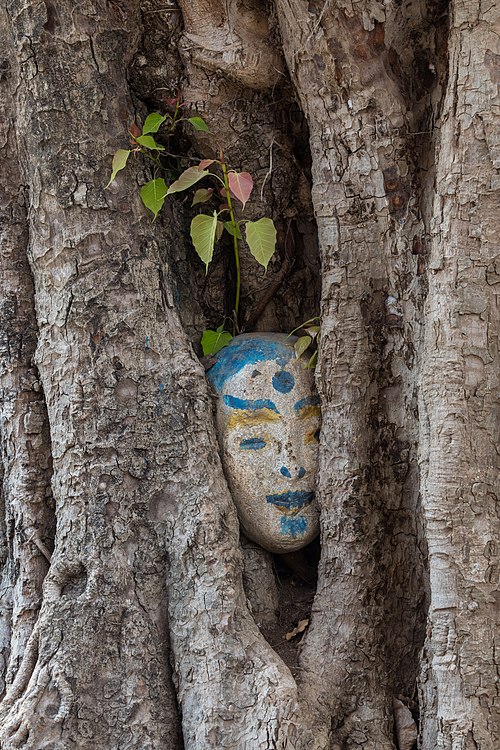
Ingrown sculpture of human head in a tree trunk in Laos