CERN
Videos
The European Organization for Nuclear Research, also called European Laboratory for Particle Physics, known as CERN, is an intergovernmental organization that operates the largest particle physics lab

CERN's main site in Meyrin, Switzerland, looking towards the French border
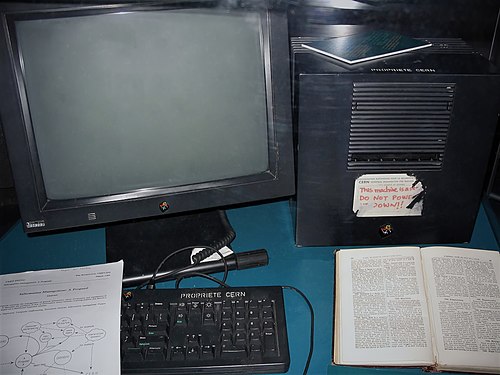
This NeXT Computer used by British scientist Sir Tim Berners-Lee at CERN became the first Web server.

This Cisco Systems router at CERN was one of the first IP routers deployed in Europe.
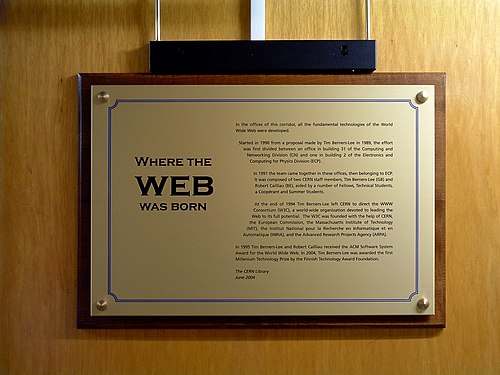
A plaque at CERN commemorating the invention of the World Wide Web by Tim Berners-Lee and Robert Cailliau
Large Hadron Collider
Videos
The Large Hadron Collider is the world's largest and highest-energy particle accelerator. It was built by the European Organization for Nuclear Research between 1998 and 2008, in collaboration with ov
CERN
…physics research – consequently, numerous experiments have been constructed at CERN through international collaborations. CERN is the site of the Large Hadron Collider (LHC), the world's largest and highest-energy particle collider. The main site at Meyrin hosts a large computing facility, which is primarily used to…

Superconducting quadrupole electromagnets are used to direct the beams to four intersection points, where interactions between accelerated protons take place.

LHC magnet cross sections, left is a dipole magnet segment and right is a quadrupole magnet segment.

The LHC protons originate from the small red hydrogen tank.

CMS detector for LHC