CK Vulpeculae
Videos
CK Vulpeculae is an object whose exact nature is unknown. It was once considered to be the oldest reliably-documented nova. It consists of a compact central object surrounded by a bipolar nebula.

CK Vulpeculae taken by ALMA. Credit: ALMA (ESO/NAOJ/NRAO)/S. P. S. Eyres

Position of the 1670 Nova near Albireo

Radioactive molecules in the remains of a stellar collision.
Brown dwarf
Videos
Brown dwarfs are substellar objects that have more mass than the biggest gas giant planets, but less than the least massive main-sequence stars. Their mass is approximately 13 to 80 times that of Jupi
CK Vulpeculae
…result of two main sequence stars colliding and merging. A 2018 study found it was most likely the result of an unusual collision of a white dwarf and a brown dwarf. A 2020 article ruled out this proposed mechanism and proposes that CK Vulpeculae is an intermediate luminosity optical transient, i.e. an object in…

Artist's concept of a T-type brown dwarf
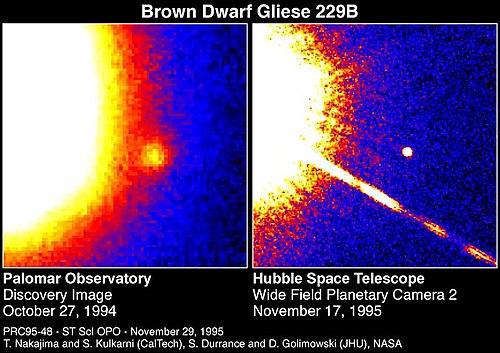
The smaller object is Gliese 229B, about 20 to 50 times the mass of Jupiter, orbiting the star Gliese 229. It is in the constellation Lepus, about 19 light-years from Earth.

Planets, brown dwarfs, stars (not to scale)

A size comparison between the Sun, a young sub-brown dwarf, and Jupiter. As the sub-brown dwarf ages, it will gradually cool and shrink.