A canal pound, reach, or level, is the stretch of level water impounded between two canal locks. Canal pounds can vary in length from the non-existent, where two or more immediately adjacent locks form a lock staircase, to many kilometres/miles.
A short pound on the Chesterfield Canal in England, United Kingdom.
A feeder canal to feed the Georgetown level of the Chesapeake and Ohio Canal.
Canal drained for winter. Note: water "stain" on lock masonry indicates normal water level.
Paddle valves closed, and boards put in. Topmost board determines height of water in pound.
A lock is a device used for raising and lowering boats, ships and other watercraft between stretches of water of different levels on river and canal waterways. The distinguishing feature of a lock is a fixed chamber in which the water level can be varied; whereas in a caisson lock, a boat lift, or on a canal inclined plane, it is the chamber itself that rises and falls.
Canal lock and lock-keeper's cottage on the Aylesbury Arm of the Grand Union Canal at Marsworth in Hertfordshire, England
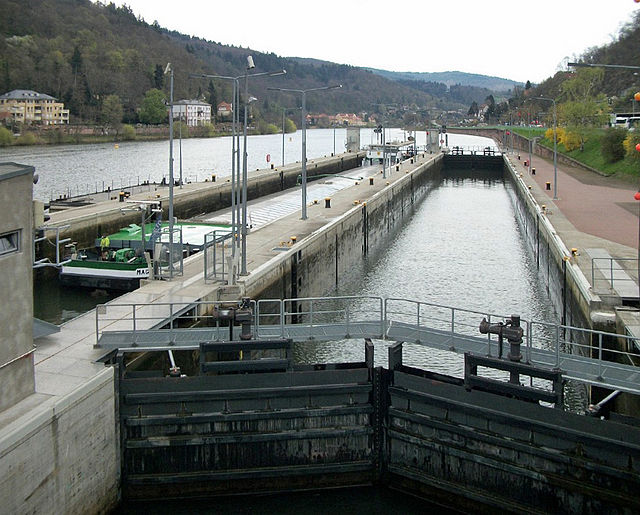
Lock on the River Neckar at Heidelberg in Germany
Three Gorges Dam lock near Yichang on Yangtze river, China
A gate in the Hatton flight in England