Carolingian Empire
Videos
The Carolingian Empire was a Frankish-dominated empire in Western and Central Europe during the Early Middle Ages. It was ruled by the Carolingian dynasty, which had ruled as kings of the Franks since
The Dorestad Brooch, Carolingian-style cloisonné jewelry from c. 800. Found in the Netherlands, 1969.


The Carolingian Empire at its greatest extent (814) and its later partition with the Treaty of Verdun (843)

Copy of the Ludwigslied, an epic poem celebrating the victory of Louis III of West Francia over the Vikings

Carolingian warrior on a war horse (8th - 10th century) with lance, round shield, chainmail and spangenhelm in the Coronation Hall of the Aachen City Hall in June 2014 on the occasion of the exhibition "Charlemagne - power, art, treasures"
Francia
Videos
The Kingdom of the Franks, also known as the Frankish Kingdom or Francia, was the largest post-Roman kingdom in Western Europe. It was established by the Franks, one of the Germanic peoples. Its found
Carolingian Empire
…and ruled until 987 with an interruption from 922 to 936. The population of the empire was roughly between 10 and 20 million people. Its heartland was Francia, the land between the Loire and the Rhine, where Aachen, which Charlemagne chose as his primary residence, was located. In the south it crossed the…

The partition of the Frankish kingdom among the four sons of Clovis with Clotilde presiding, Grandes Chroniques de France (Bibliothèque municipale de Toulouse)
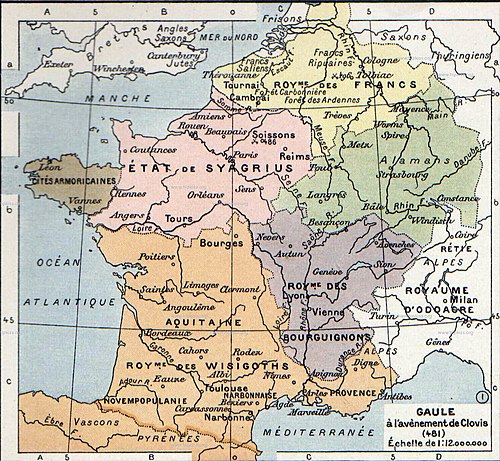
The political divisions of Gaul at the inception of Clovis's career (481). Note that only the Burgundian kingdom and the province of Septimania remained unconquered at his death (511).

The division of the Frankish kingdom on Clovis's death (511). The kingdoms were not geographic unities because they were formed in an attempt to create equal-sized fiscs. The discrepancy in size reveals the concentration of Roman fiscal lands.
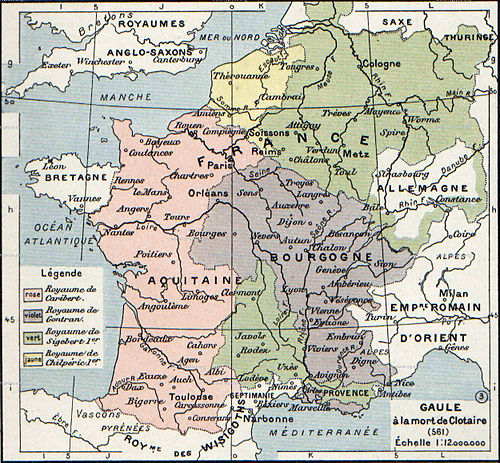
The division of Gaul on Chlothar I's death (561). Though more geographically unified realms were created out of the second fourfold division, the complex division of Provence created many problems for the rulers of Burgundy and Austrasia.