Caste
Videos
A caste is a fixed social group into which an individual is born within a particular system of social stratification: a caste system. Within such a system, individuals are expected to marry exclusivel

The Basor weaving bamboo baskets in a 1916 book. The Basor are a Scheduled Caste found in the state of Uttar Pradesh in India.

An image of a man and woman from the toddy-tapping community in Malabar from the manuscript Seventy-two Specimens of Castes in India, which consists of 72 full-color hand-painted images of men and women of various religions, occupations and ethnic groups found in Madura, India in 1837, which confirms the popular perception and nature of caste as Jati, before the British colonial authorities made it applicable only to Hindus grouped under the varna categories from the 1901 census onwards

Members of various Hindu castes, 1874

A Sudra caste man from Bali. Photo from 1870, courtesy of Tropenmuseum, Netherlands.
India
Videos
India, officially the Republic of India, is a country in South Asia. It is the world's seventh-largest country by area and the largest by population. Bounded by the Indian Ocean on the south, the Arab
Caste
…to morphological groupings in eusocial insects such as ants, bees, and termites. The paradigmatic ethnographic example of caste is the division of India's Hindu society into rigid social groups. Its roots lie in South Asia's ancient history, and it still persists. A subject of much scholarship by…
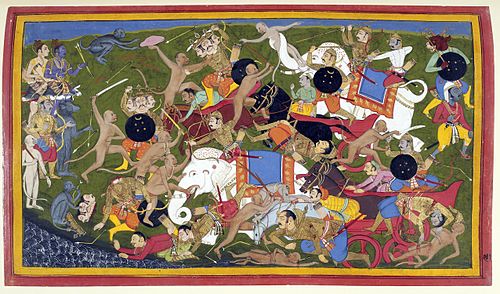
Manuscript illustration, c. 1650, of the Sanskrit epic Ramayana, composed in story-telling fashion c. 400 BCE – c. 300 CE

Cave 26, a Buddhist shrine, of the rock-cut Ajanta Caves

The Brihadisvara Temple, built by Chola monarch Rajaraja I between 1003 and 1010 CE

Calligraphy on the Qutb Minar, built in the Delhi sultanate from 1199 CE to 1220 CE