Catilinarian orations
Videos
The Catilinarian orations are four speeches given in 63 BC by Marcus Tullius Cicero, one of the year's consuls. The speeches are all related to the discovery, investigation, and suppression of the Cat

End of the 4th Catiliniarian Oration, in a manuscript written by Poggio Bracciolini. Florence, Biblioteca Medicea Laurenziana, Plut. 48,22, fol. 121r.

Marcus Tullius Cicero
Catilinarian conspiracy
Videos
The Catilinarian conspiracy, sometimes Second Catilinarian conspiracy, was an attempted coup d'état by Lucius Sergius Catilina to overthrow the Roman consuls of 63 BC – Marcus Tullius Cicero and Gaius
Catilinarian orations
…given in 63 BC by Marcus Tullius Cicero, one of the year's consuls. The speeches are all related to the discovery, investigation, and suppression of the Catilinarian conspiracy, a plot that year to overthrow the republic. All of the speeches in the form available today were published, probably around 60, as part of Cicero's…
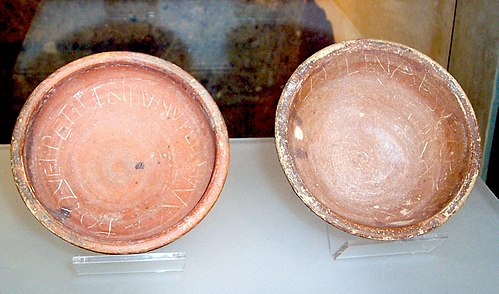
Bowls containing food distributed in electoral canvasses. The bowl to the right was commissioned by Lucius Cassius Longinus and distributed in support of Catiline's consular candidacy in 63 BC. The bowl on the left was distributed by Marcus Porcius Cato in a coeval campaign for the plebeian tribunate.

A 1st century AD depiction of Cicero, one of the consuls in 63 BC and one of the leaders of the response against Catiline, today in the Capitoline Museum.

A denarius minted by Lucius Scribonius Libo in 62 BC. The portrayal of Bonus Eventus on the obverse likely commemorates the repression of Catiline's conspiracy.

A denarius minted by Lucius Aemilius Paullus in 62 BC commemorating Catiline's defeat. It depicts the goddess Concordia, on the left. Berry 2020, p. 54 argues that Paullus attempted to connect Catiline's defeat to peace.