Ceryneian Hind
Videos
In Greek mythology, the Ceryneian hind, was the enormous hind of Ceryneia, larger than a bull, with golden antlers like a stag, hooves of bronze or brass, and a "dappled hide", that "excelled in swift

Heracles breaking off the golden antler of the Ceryneian Hind, while Athena (left) and Artemis look on (black-figure amphora, ca. 540–30 BC)

Heracles and Apollo struggling over the Hind, as depicted on a Corinthian helmet (early 5th century BC)

Athenian plate, c. 560 BC

Roman bronze, 1st century BC, probably a copy from Lysippus
Labours of Hercules
Videos
The Labours of Hercules or Labours of Heracles are a series of tasks carried out by Heracles, the greatest of the Greek heroes, whose name was later romanised as Hercules. They were accomplished in th
Ceryneian Hind
…bronze or brass, and a "dappled hide", that "excelled in swiftness of foot", and snorted fire. To bring her back alive to Eurystheus in Mycenae was the third labour of Heracles. Other names and descriptions for her were: doe with the golden horns, golden-horned hind, Ceryneia hind, Cerynitian hind, beast with golden antlers…
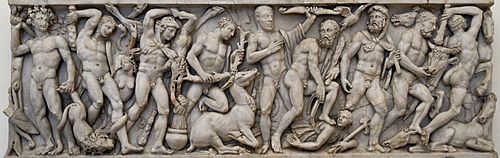
Roman relief (3rd century AD) depicting a sequence of the Labours, representing from left to right the Nemean lion, the Lernaean Hydra, the Erymanthian Boar, the Ceryneian Hind, the Stymphalian birds, the Girdle of Hippolyta, the Augean stables, the Cretan Bull and the Mares of Diomedes

Roman mosaic (3rd century CE) showing the Twelve Labours from Llíria (Valencia, Spain). Now in the Museo Arqueológico Nacional.

The Heracles Papyrus, a fragment of a 3rd-century CE Greek manuscript of a poem about the Labours of Heracles (Oxyrhynchus Papyrus 2331)

The Origin of the Milky Way by Jacopo Tintoretto, 1575