Chagai-I
Videos
Chagai-I is the code name of five simultaneous underground nuclear tests conducted by Pakistan on 28 May 1998 at 15:15 PKT. The tests were performed at Ras Koh Hills in the Chagai District of Balochis

The dust expulsion from the Ras Koh Hills following the underground nuclear detonation

PAEC's scientists chose sites at the high-altitude granite mountain ranges with extreme hot weather.

The PAEC weapon testing team at Koh Kambaran, with team leader Samar Mubarakmand (right of the man in the blue beret), Tariq Salija, Irfan Burney, and Tasneem Shah. The better known A. Q. Khan of Kahuta Research Laboratories (KRL) is left of the man in the blue beret (who may be General Zulfikar Ali).

Commemorative monument at the Faizabad Interchange in Islamabad
Nuclear weapon
Videos
A nuclear weapon is an explosive device that derives its destructive force from nuclear reactions, either nuclear fission or a combination of fission and nuclear fusion reactions, producing a nuclear
Chagai-I
…to India's second nuclear tests, Pokhran-II, also called Operation Shakti, on 11 and 13 May 1998. Chagai-I was Pakistan's first of two public tests of nuclear weapons. Pakistan's second nuclear test, Chagai-II, followed on 30 May 1998. In 2005, Benazir Bhutto testified, "Pakistan may have had an atomic device long…
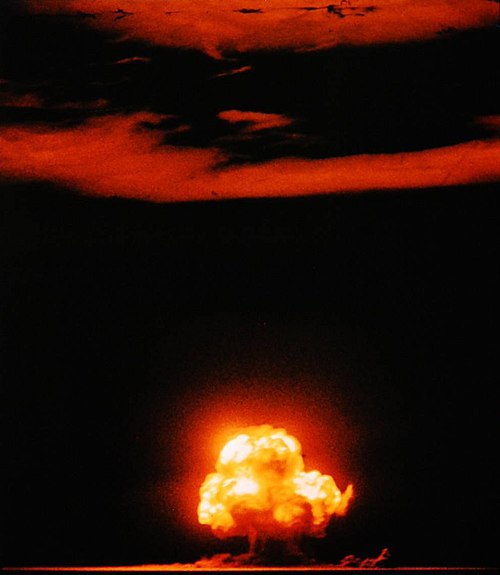
The Trinity test of the Manhattan Project was the first detonation of a nuclear weapon, which led J. Robert Oppenheimer to recall verses from the Hindu scripture Bhagavad Gita: "If the radiance of a thousand suns were to burst at once into the sky, that would be like the splendor of the mighty one" ... "I am become Death, the destroyer of worlds".

Edward Teller, often referred to as the "father of the hydrogen bomb"

Soviet OTR-21 Tochka missile. Capable of firing a 100-kiloton nuclear warhead a distance of 185 km

The first nuclear weapons were gravity bombs, such as the "Fat Man" weapon dropped on Nagasaki, Japan. They were large and could only be delivered by heavy bomber aircraft