Charles V was Holy Roman Emperor and Archduke of Austria from 1519 to 1556, King of Castile and León from 1516 to 1556, King of Sicily and Naples from 1516 to 1554, and also Lord of the Netherlands an
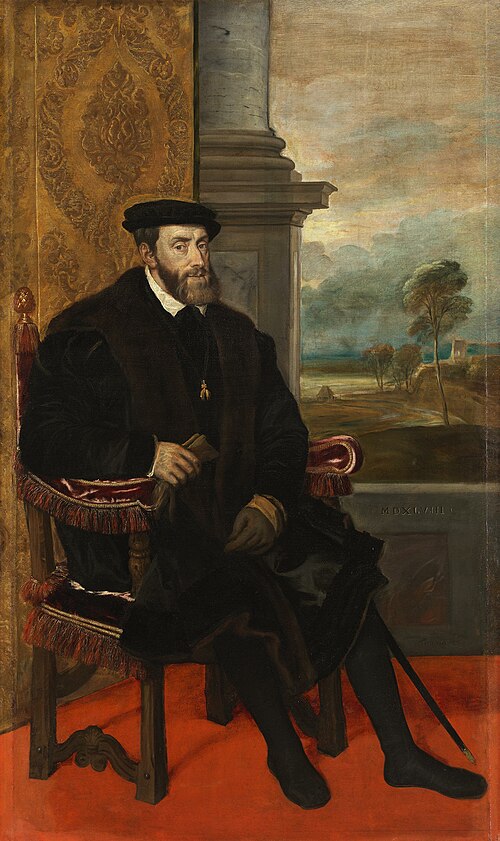
Portrait of Charles V, 1548

The entrance gate to the Prinsenhof, Dutch for "Princes' Court", in Ghent, where Charles V was born.

A painting by Bernhard Strigel representing the extended Habsburg family with a young Charles in the middle

A 1519 portrait of Charles V by Bernard van Orley with the insignia of the Order of the Golden Fleece prominently displayed
Joanna of Castile
Videos
Joanna or Joan was Queen of Castile from 1504 and Queen of Aragon from 1516 to her death in 1555. She was the daughter of Queen Isabella I of Castile and King Ferdinand II of Aragon. Joanna was marrie
Charles V, Holy Roman Emperor
…never sets". Charles was born in Flanders to Habsburg Archduke Philip the Handsome, son of Maximilian I, Holy Roman Emperor and Mary of Burgundy, and Joanna of Castile, younger child of Isabella I of Castile and Ferdinand II of Aragon, the Catholic Monarchs of Spain. Heir of his grandparents, Charles inherited his…

Portrait by Juan de Flandes, c. 1500

Joanna with her parents, Isabella and Ferdinand; "Rimado de la conquista de Granada", by Pedro Marcuello, c. 1482

The marriage contract of Joanna and Philip (1496).

Joanna of Castile and Philip the Fair, stained glass, Basilica of the Holy Blood in Bruges.