Holy Roman Emperor
Videos
The Holy Roman Emperor, originally and officially the Emperor of the Romans during the Middle Ages, and also known as the Roman-German Emperor since the early modern period, was the ruler and head of
Longest reigning Frederick III 19 March 1452 – 19 August 1493
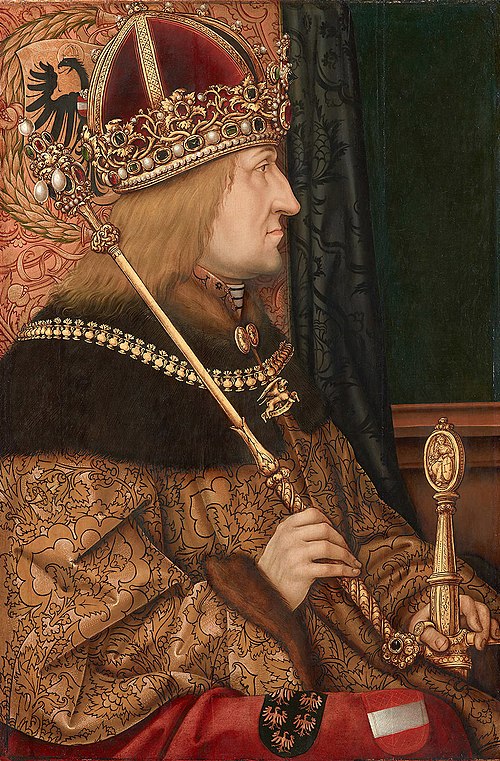
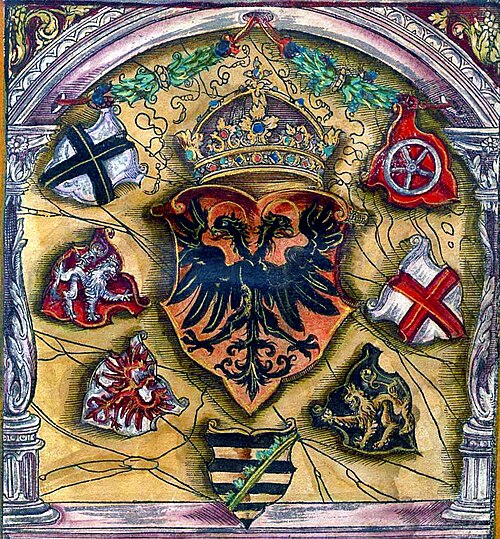
Coats of arms of prince electors surround the imperial coat of arms; from a 1545 armorial. Electors voted in an Imperial Diet for a new Holy Roman Emperor.

Depiction of Charlemagne in a 12th-century stained glass window, Strasbourg Cathedral, now at Musée de l'Œuvre Notre-Dame.
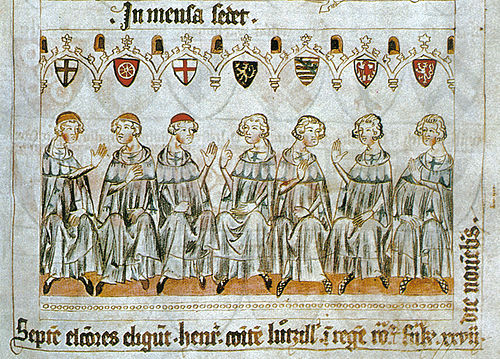
Illustration of the election of Henry VII (27 November 1308) showing (left to right) the Archbishop of Cologne, Archbishop of Mainz, Archbishop of Trier, Count Palatine of the Rhine, Duke of Saxony, Margrave of Brandenburg and King of Bohemia (Codex Balduini Trevirorum, c. 1340).
Francis II and I was the last Holy Roman Emperor as Francis II from 1792 to 1806, and the first Emperor of Austria as Francis I from 1804 to 1835. He was also King of Germany, Hungary, Croatia and Boh
Holy Roman Emperor
…interruption) from 1452 to 1806. The final emperors were from the House of Habsburg-Lorraine, from 1765 to 1806. The Holy Roman Empire was dissolved by Francis II, after a devastating defeat by Napoleon at the Battle of Austerlitz. The emperor was widely perceived to rule by divine right, though he often contradicted…

Portrait by Friedrich von Amerling, c. 1832

1770 painting by Anton Raphael Mengs depicting Archduke Francis at the age of 2

Francis I as Austrian Emperor wearing the Order of the Golden Fleece, undated
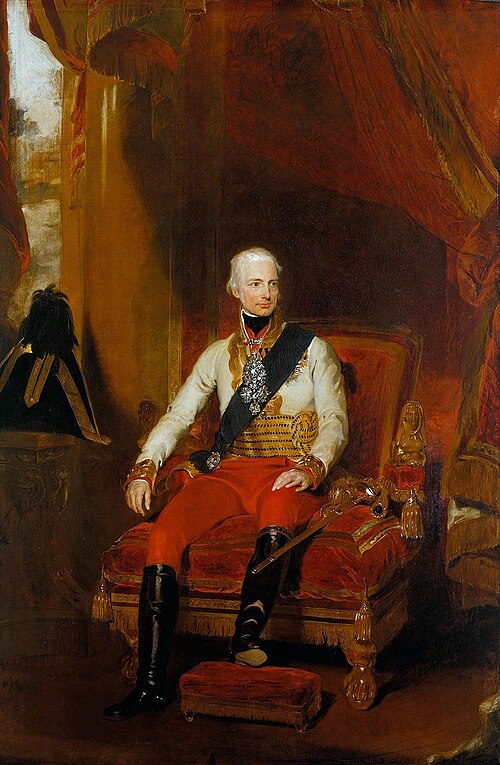
Portrait of Francis I of Austria, by Thomas Lawrence, c. 1818–1819