Claudius
Videos
Tiberius Claudius Caesar Augustus Germanicus, or simply Claudius, was a Roman emperor, ruling from AD 41 until his death in AD 54. The fourth ruler of the Julio-Claudian dynasty, Claudius was born to
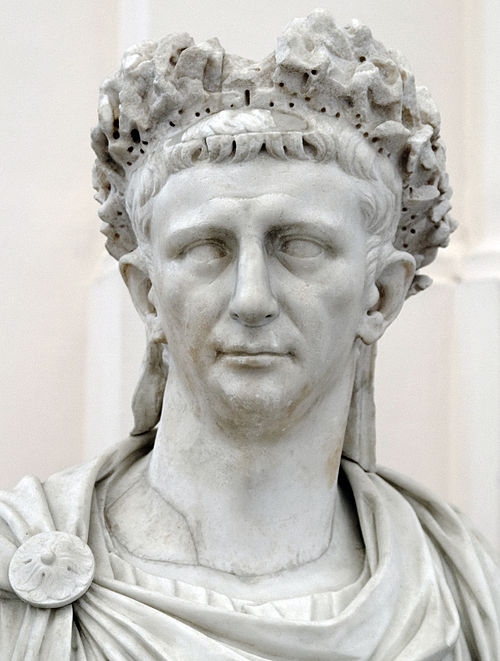
Roman marble bust of Claudius, wearing a corona civica, Naples National Archaeological Museum

A coin of Herod of Chalcis, showing him with his brother Agrippa of Judaea crowning Claudius, AD 43.

Detail from A Roman Emperor 41 AD, c. 1871.

Aureus struck at the Lugdunum (Lyon) mint, AD 41. The reverse commemorates the "reception of the emperor" (imperator receptus) at the Praetorian Camp and the protection the Praetorian Guard afforded him in the days following the assassination of Caligula. Issued over a number of years in both gold and silver, these types of coins were struck to serve as part of the annual military payments Claudius had promised the Guard in return for their role in raising him to the throne. Caption: TI. CLAVD. CAESAR AVG. P. M., TR. P. / IMPER. RECEPT.
Messalina
Videos
Valeria Messalina was the third wife of Roman emperor Claudius. She was a paternal cousin of Emperor Nero, a second cousin of Emperor Caligula, and a great-grandniece of Emperor Augustus. A powerful a
Claudius
…censorship, 48, is detailed in book 11 of Tacitus's Annals. This section of Tacitus's history narrates the alleged conspiracy of Claudius's third wife, Messalina. Suetonius states that a total of 35 senators and 300 knights were executed for offenses during Claudius's reign. Suetonius and the other ancient authors…

Statue of Messalina holding her son Britannicus, at the Louvre, ca 45 CE

Messalina in a coin minted in Crete, c. AD 42

A bust believed to be of Messalina, in the Uffizi Gallery in Florence

Messalina guides the dragon chariot in the triumph of Claudius. Sardonyx cameo plaque in enamelled frame. (Cabinet des Médailles, Paris)