Climate change in the Arctic
Videos
Due to climate change in the Arctic, this polar region is expected to become "profoundly different" by 2050. The speed of change is "among the highest in the world", with warming occurring at 3-4 time
The image above shows where average air temperatures (October 2010 – September 2011) were up to 2 degrees Celsius above (red) or below (blue) the long-term average (1981–2010).


Potential regional warming caused by the loss of all land ice outside of East Antarctica, and by the disappearance of Arctic sea ice every year starting from June. While plausible, consistent sea ice loss would likely require relatively high warming, and the loss of all ice in Greenland would require multiple millennia.

The dark ocean surface reflects only 6 percent of incoming solar radiation, while sea ice reflects 50 to 70 percent.

Month-by-month chart shows how minimum ice volume usually occurs in September, and maxima usually occurring in April.
Arctic Ocean
Videos
The Arctic Ocean is the smallest and shallowest of the world's five oceanic divisions. It spans an area of approximately 14,060,000 km2 and is the coldest of the world's oceans. The International Hydr

Thule archaeological site
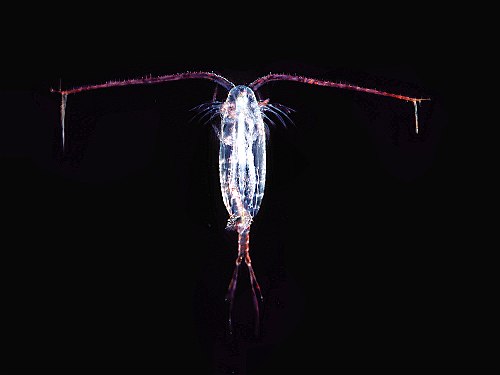
A copepod

Sea cover in the Arctic Ocean, showing the median, 2005 and 2007 coverage

On the sea ice of the Arctic Ocean temporary logistic stations may be installed. Here, a Twin Otter is refueled on the pack ice at 86°N, 76°43‘W. on April 16, 1990 during a flight to the North Pole