Cloverly Formation
Videos
The Cloverly Formation is a geological formation of Early and Late Cretaceous age that is present in parts of Montana, Wyoming, Colorado and Utah in the western United States. It was named in 1904 by

Brightly colored strata of the Himes Member of the Cloverly Formation near Shell, Wyoming

Aquilops

Zephyrosaurus

Sauroposeidon
Acrocanthosaurus
Videos
Acrocanthosaurus is a genus of carcharodontosaurid dinosaurs that existed in what is now North America during the Barremian and early Cenomanian stages of the Early Cretaceous and Late Cretaceous, fro
Cloverly Formation
…sauropod within Somphospondyli Theropods Theropods reported from the Cloverly Formation Genus Species State Stratigraphic position Material Notes Images Acrocanthosaurus A. atokensis Wyoming Cloverly VII; Himes Member A partial skeleton consists of a dorsal vertebral centrum, caudal vertebral neural arch, right and left…

Acrocanthosaurus skeleton

Cast of an Acrocanthosaurus atokensis skeleton (NCSM 14345) mounted at the Museum of the Red River, Idabel, Oklahoma.

Skeletal diagram
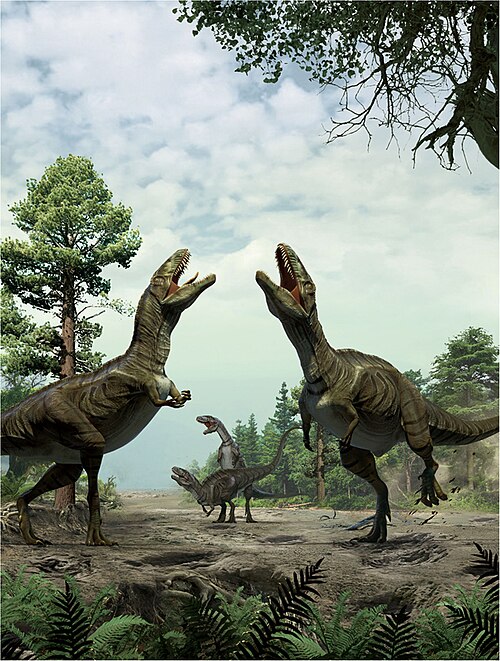
Restoration of a pair of Acrocanthosaurus engaging in courtship behavior