Over its long history, the Holy Roman Empire used many different heraldic forms, representing its numerous internal divisions.
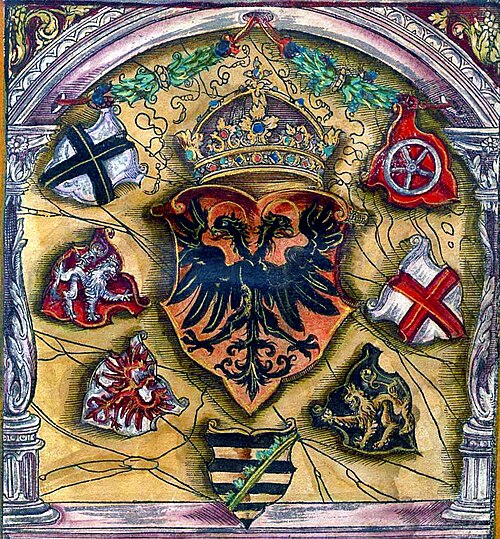
Coats of arms of prince electors surrounding the double-headed Reichsadler (1545).

Imperial Habsburg coat of arms, for Rudolf II, from Siebmachers Wappenbuch (1605). The surrounding coats of arms represent Habsburg possessions, the inescutcheon exceptionally combines the Austrian and Castilian arms, for Habsburg Austria and Habsburg Spain.

The Quaternion Eagle, hand-coloured woodcut (c. 1510) by Hans Burgkmair.
Coat of arms of Germany
Videos
The coat of arms of Germany, also known as the Bundeswappen, displays a black eagle with a red beak, a red tongue and red feet on a golden field, which is blazoned: Or, an eagle displayed sable beaked
Coats of arms of the Holy Roman Empire
…divisions. The Reichsadler ("Imperial Eagle") was the heraldic eagle, derived from the Roman eagle standard, used by the Holy Roman Emperors and in modern coats of arms of Germany, including those of the Second German Empire (1871–1918), the Weimar Republic (1919–1933) and the "Third Reich" (Nazi Germany, 1933–1945). The same…

Coat of arms of the Holy Roman Empire with two putti (1540s manuscript)

Imperial coat of arms (Römischer Kayserlicher und Königlicher Mayestät Wappen) from Siebmachers Wappenbuch (1605)

Germany's first national parliament meeting in Frankfurt. The double-headed eagle, now without the haloes of the Holy Roman Emperor's eagle, can be seen.

Title page of the Constitution of the Weimar Republic, with Schwab's design of the coat of arms