Coffin Texts
Videos
The Coffin Texts are a collection of ancient Egyptian funerary spells written on Ancient Egyptian coffins beginning in the First Intermediate Period. They are partially derived from the earlier Pyrami
Middle Kingdom coffin with the Coffin Texts painted on its panels


Dismantled coffin of Khety c. 1919–1800 BCE with Coffin Text spells painted on the inside panels

Dismantled coffin of Khety c. 1919–1800 BCE with Coffin Text spells painted on the inside panels
Duat
Videos
The Duat or Tuat is a concept in ancient Egyptian mythology involving death. It is most often seen as a realm where people go after they die. Due to linguistic shifts within Ancient Egypt, the Duat ha
Coffin Texts
…focus on the celestial realm, the coffin texts emphasize the subterranean elements of the afterlife ruled by the deity Osiris, in a place called the Duat. An Osirian afterlife is offered to everyone, and the deceased is even referred to as "the Osiris-[name]." This subterranean realm is described as being…
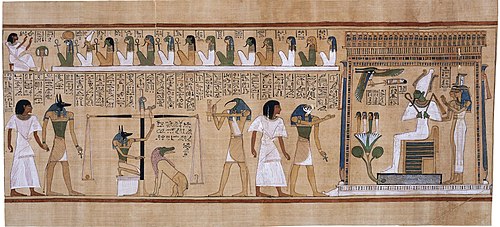
The 'Weighing of the Heart' from the Book of the Dead from the Papyrus of Hunefer, dated to the 19th Dynasty around 1275 BCE. The deceased Hunefer is taken into the judgment hall by the deity Anubis, who weighs a portion of Hunefer's soul, represented by his heart. This ritual is completed with Ammit the Devourer awaiting the result, and Thoth recording. Next, the triumphant Hunefer, having passed the test, is presented by the falcon-headed Horus to

A'aru, 'The Field of Reeds' from the Papyrus of Ani

The 42 Judges of Ma'at who sit as jury during the 'Weighing of the Heart'

Af or Afu (commonly known as Afu-Ra), the ram-headed form of Ra when traveling the Duat on the subterrestrial Nile (the 12 hours of night and the underworld) on the Mesektet barque along with Sia (left and front of barque) and Heka (right and behind of barque), surrounded by the protective coiled serpent deity Mehen