Colosseum
Videos
The Colosseum is an elliptical amphitheatre in the centre of the city of Rome, Italy, just east of the Roman Forum. It is the largest ancient amphitheatre ever built, and is the largest standing amphi

Looking east from the Piazza di Santa Francesca Romana, 2020

Interior of the Colosseum by late nineteenth century photographer Francis Frith
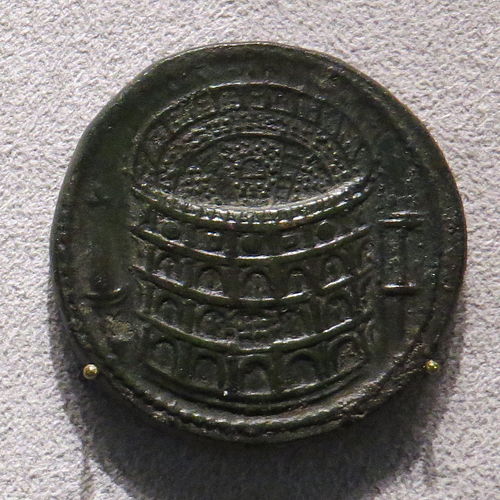
Sestertius of Titus celebrating the inauguration of the Colosseum (minted 80 AD).

The Colosseum in the 1530s, sketched by Maarten van Heemskerck, and used as the model for his later Self-Portrait with the Colosseum and Octo Mundi Miracula.
Gladiator
Videos
A gladiator was an armed combatant who entertained audiences in the Roman Republic and Roman Empire in violent confrontations with other gladiators, wild animals, and condemned criminals. Some gladiat
Colosseum
…It could hold an estimated 50,000 to 80,000 spectators at various points in its history, having an average audience of some 65,000; it was used for gladiatorial contests and public spectacles including animal hunts, executions, re-enactments of famous battles, dramas based on Roman mythology, and briefly mock…
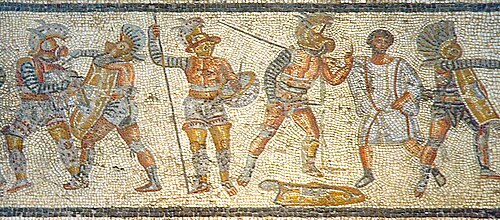
Part of the Zliten mosaic from Libya (Leptis Magna), about 2nd century AD. It shows (left to right) a thraex fighting a murmillo, a hoplomachus standing with another murmillo (who is signaling his defeat to the referee), and one of a matched pair.

Relief of gladiators from Amphitheatre of Mérida, Spain

A retiarius stabs at a secutor with his trident in this mosaic from the villa at Nennig, Germany, c. 2nd–3rd century AD.

Roman glassware decorated with a gladiator, dated 52–125 AD and found at Begram, Afghanistan, a royal city of the Kushan Empire where, according to Warwick Ball, it was likely on its way to Han dynasty China via the Silk Road along with other glass items.