Colossus of Nero
Videos
The Colossus of Nero was a 30-metre bronze statue that the Emperor Nero created in the vestibule of his Domus Aurea, the imperial villa complex which spanned a large area from the north side of the Pa

Base of the Colossus of Nero near the Colosseum, prior to its removal

Coin of Emperor Nero showing the Colossus. Legend NERO CAESAR / AVGVSTVS GERMANICVS

Medallion showing on obverse Gordianus III, legend IMP GORDIANVS PIVS FELIX AVG. Reverse: bull contending with elephant within the Colosseum, seen from above; Colossus of Nero and Meta Sudans, and the Temple of Venus and Rome, or the Ludus Magnus on either side; legend MVNIFICENTIA GORDIANI AVG

Obverse: Laureate and draped bust of Severus Alexander to right, legend IMP CAES M AVREL SEV ALEXANDER AVG. Reverse: The Amphitheatrum Flavianum (”The Colosseum”). It is shown from the front, with four stories: the first with arches, the second with arches containing statues, the third with flat-topped pedimented niches containing statues, and the fourth with square windows and circular clupea; in a bird's eye view the circular interior can also be seen with two tiers of spectators. Outside, to left, Severus Alexander stands right sacrificing over a low altar; behind him is the Meta Sudans and a large statue of Sol. To right, a two-storied distyle building with two pediments and a male statue (Jupiter?) before. Legend PONTIF MAX TR P III COS P P
Colosseum
Videos
The Colosseum is an elliptical amphitheatre in the centre of the city of Rome, Italy, just east of the Roman Forum. It is the largest ancient amphitheatre ever built, and is the largest standing amphi
Colossus of Nero
…Esquiline Hill in Rome. It was modified by Nero's successors into a statue of the sun god Sol. The statue was eventually moved to a spot outside the Flavian Amphitheatre, which (according to one of the more popular theories) became known, by its proximity to the Colossus, as the Colosseum. The last mention of the Colossus…

Looking east from the Piazza di Santa Francesca Romana, 2020

Interior of the Colosseum by late nineteenth century photographer Francis Frith
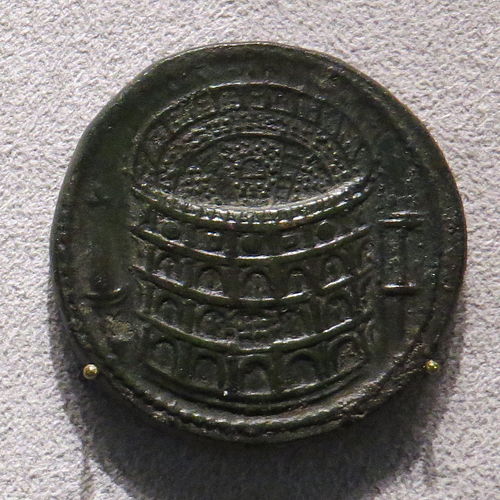
Sestertius of Titus celebrating the inauguration of the Colosseum (minted 80 AD).

The Colosseum in the 1530s, sketched by Maarten van Heemskerck, and used as the model for his later Self-Portrait with the Colosseum and Octo Mundi Miracula.