Computer programming
Videos
Computer programming or coding is the composition of sequences of instructions, called programs, that computers can follow to perform tasks. It involves designing and implementing algorithms, step-by-
Ada Lovelace, whose notes were added to the end of Luigi Menabrea's paper included the first algorithm designed for processing by Charles Babbage's Analytical Engine. She is often recognized as history's first computer programmer.


Data and instructions were once stored on external punched cards, which were kept in order and arranged in program decks.

Wired control panel for an IBM 402 Accounting Machine. Wires connect pulse streams from the card reader to counters and other internal logic and ultimately to the printer.

The first known actual bug causing a problem in a computer was a moth, trapped inside a Harvard mainframe, recorded in a log book entry dated September 9, 1947. "Bug" was already a common term for a software defect when this insect was found.
Programming language
Videos
A programming language is an engineered language for expressing computer programs, typically allowing software to be written in a human readable manner.
Computer programming
…follow to perform tasks. It involves designing and implementing algorithms, step-by-step specifications of procedures, by writing code in one or more programming languages. Programmers typically use high-level programming languages that are more easily intelligible to humans than machine code, which is directly executed…

Two people using an IBM 704 mainframe—the first hardware to support floating-point arithmetic—in 1957. Fortran was designed for this machine.
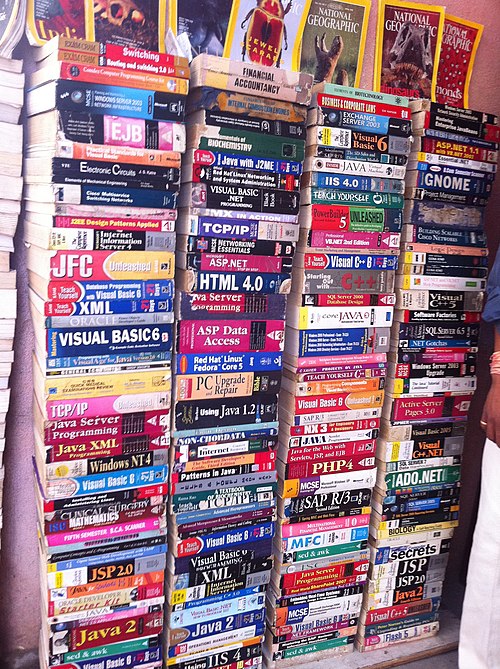
A small selection of programming language textbooks on sale in Bangalore, India, 2011