Conjunction (astronomy)
Videos
In astronomy, a conjunction occurs when two astronomical objects or spacecraft appear to be close to each other in the sky. This means they have either the same right ascension or the same ecliptic lo
Visual conjunction between the Moon and the planet Venus, the two brightest objects in the night sky


A conjunction of Mars and Jupiter in the morning of 1 May 2011, when, about an hour before sunrise, five of the Solar System's eight planets and the Moon could be seen from Cerro Paranal, Chile.

In the night sky over ESO's Very Large Telescope (VLT) observatory at Paranal, the Moon shines along with two bright companions: Venus and Jupiter.
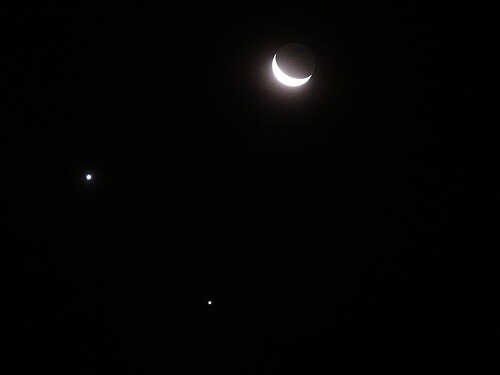
Conjunction of Venus (left) and Jupiter (bottom), with the nearby crescent Moon, seen from São Paulo, Brazil, on 1 December 2008
Venus
Videos
Venus is the second planet from the Sun. Similar in size and mass to Earth, Venus has no liquid water, and its atmosphere is far thicker and denser than that of any other rocky body in the Solar Syste
Conjunction (astronomy)
…Sun as seen from the inferior planet. The terms "inferior conjunction" and "superior conjunction" are used in particular for the planets Mercury and Venus, which are inferior planets as seen from Earth. However, this definition can be applied to any pair of planets, as seen from the one farther from the…

False color image of Venus as taken by Mariner 10 in 1974.

Spherical view of radar data of the surface of Venus, highlighting surface features (1989, Magellan). The colours do not represent the appearance of the surface in visible light.

Radar mosaic of two pancake domes in Venus's Eistla region—both 65 km (40 mi) wide and less than 1 km (0.62 mi) high

Impact craters on the surface of Venus (false-colour, 3D projection image reconstructed from radar data)