Contubernium
Videos
In ancient Rome, contubernium was a quasi-marital relationship between two slaves or between a slave and a free person who was usually a former slave or the child of a former slave. A slave involved i
Funerary monument set up by Iulia Thallusa for herself and her contubernalis, the sevir augustalis Lucius Iulius Hesychus (2nd century CE, Musée de la Romanité, Nîmes)


An imperial slave named Antiochus, reared as a verna (within the household he was born into), commemorated the death of his "well-deserving" contubernalis Valeria Fortunata in this Latin-Greek bilingual inscription, found along the Stoa of Attalus

Funerary altar of the freedwoman Volusia Arbuscula (CIL 6.9424, latter 1st century AD), the contubernalis carissima of Pallans, slave of the consul Q. Volusius Saturninus, from the columbarium of the Volusii along the Appian Way, on display at the Musée Condé, Chantilly

Inscription commemorating Caenis, described by the historian Suetonius as the "almost wife" of Vespasian
Marriage in ancient Rome
Videos
Marriage was a fundamental institution of society in ancient Rome and was used by Romans primarily as a tool for interfamilial alliances. The institution of Roman marriage was a practice of marital mo
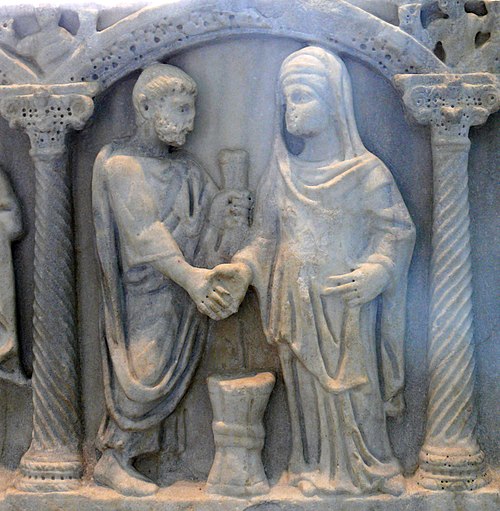
Roman couple joining hands (dextrarum iunctio); the bride's belt may show the knot symbolizing that the husband was "belted and bound" to her, which he was to untie in their bed (4th century sarcophagus)

Detail of a gold glass medallion with a portrait of a family, from Alexandria (Roman Egypt), 3rd–4th century (Brescia, Museo di Santa Giulia)

Inscription (CIL 14.5326) from Ostia Antica recording a decree that newlyweds are to pray and sacrifice before the altar to the imperial couple Antoninus Pius and Faustina as exemplifying Concordia, marital harmony

A groom encourages his demure bride while a servant looks on; wall painting, Casa della Farnesina in Rome (c. 19 BC)