Cosmic microwave background
Videos
The cosmic microwave background, or relic radiation, is microwave radiation that fills all space in the observable universe. With a standard optical telescope, the background space between stars and g

The Holmdel Horn Antenna on which Penzias and Wilson discovered the cosmic microwave background.

Comparison of CMB results from COBE, WMAP and Planck (March 21, 2013)

Artist impression of the gravitational lensing effect of massive cosmic structures

Temperature power spectrum and E-mode and B-mode polarization power spectra of the cosmic microwave background
Microwave
Videos
Microwave is a form of electromagnetic radiation with wavelengths shorter than other radio waves but longer than infrared waves. Its wavelength ranges from about one meter to one millimeter, correspon
Cosmic microwave background
…The cosmic microwave background (CMB, CMBR), or relic radiation, is microwave radiation that fills all space in the observable universe. With a standard optical telescope, the background space between stars and galaxies is almost completely…
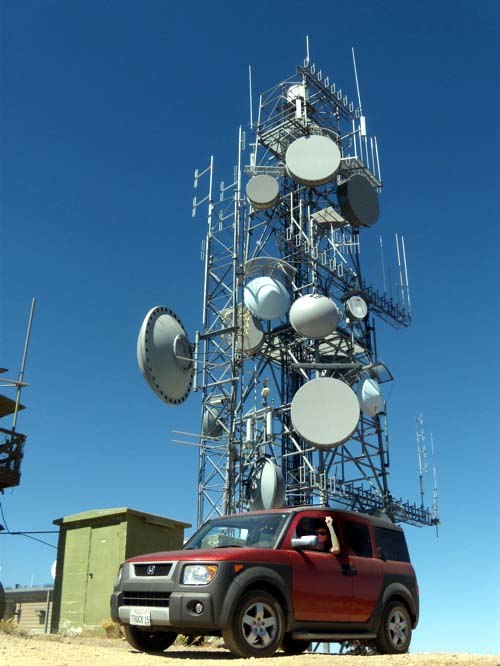
A telecommunications tower with a variety of dish antennas for microwave relay links on Frazier Peak, Ventura County, California. The apertures of the dishes are covered by plastic sheets (radomes) to keep out moisture.

Waveguide is used to carry microwaves. Example of waveguides and a diplexer in an air traffic control radar.

Disassembled radar speed gun. The grey assembly attached to the end of the copper-colored horn antenna is the Gunn diode which generates the microwaves.

The parabolic antenna (lower curved surface) of an ASR-9 airport surveillance radar which radiates a narrow vertical fan-shaped beam of 2.7–2.9 GHz (S band) microwaves to locate aircraft in the airspace surrounding an airport