Cradle of Aviation Museum
Videos
The Cradle of Aviation Museum is an aerospace museum located in Uniondale, New York on Long Island, established to commemorate Long Island's part in the history of aviation. It is located on land once part of Mitchel Air Force Base which, together with nearby Roosevelt Field and other airfields on the Hempstead Plains, was the site of many historic flights. So many seminal flights had occurred in the area that, by the mid-1920s, the cluster of airfields was already dubbed the "Cradle of Aviation", the origin of the museum's name.


Lobby of the Museum with Grumman F-11F and Fleet Model 2 biplane

Curtiss Golden Flyer replica

Grumman F3F-2
Apollo Lunar Module
Videos
The Apollo Lunar Module, originally designated the Lunar Excursion Module (LEM), was the lunar lander spacecraft that was flown between lunar orbit and the Moon's surface during the United States' Apollo program. It was the first crewed spacecraft to operate exclusively in the airless vacuum of space, and remains the only crewed vehicle to land anywhere beyond Earth.
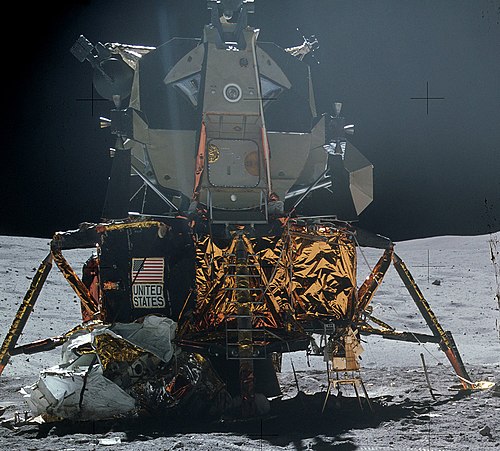
Apollo 16 LM Orion on the lunar surface, 1972
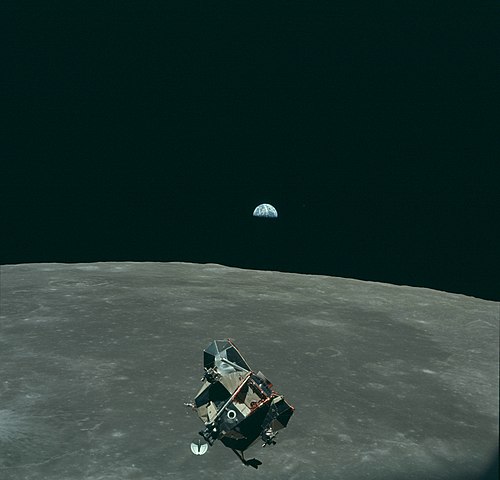
Lunar Module Eagle, the lunar module ascent stage of Apollo 11, in orbit above the Moon. Earth is visible in the distance. Photograph by Michael Collins aboard the Command module Columbia.

A 1962 model of the first LEM design, docked to the command and service module. The model is held by Joseph Shea, the key engineer behind the adoption of lunar orbit rendezvous mission logistics.

This 1963 model depicts the second LEM design, which gave rise to informal references as "the bug".