Crookes tube
Videos
A Crookes tube is an early experimental discharge tube with partial vacuum invented by English physicist William Crookes and others around 1869–1875, in which cathode rays, streams of electrons, were

Experimental Crookes tube belonging to Wilhelm Röntgen, c. 1890, at Gedächtnisstätte Würzburg (Rontgen Memorial), Würzburg, Germany

A Crookes tube: light and dark. Electrons (cathode rays) travel in straight lines from the cathode (left), as shown by the shadow cast by the metal Maltese cross on the fluorescence of the righthand glass wall of the tube. The anode is the electrode at the bottom

William Crookes and his glowing tubes gained renown, as shown by this 1902 caricature in Vanity Fair. The caption read "ubi Crookes ibi lux", which in Latin means roughly, "Where there is Crookes, there is light"

Crookes X-ray tube from around 1910
X-ray
Videos
An X-ray is a form of high-energy electromagnetic radiation with a wavelength shorter than those of ultraviolet rays and longer than those of gamma rays. Roughly, X-rays have a wavelength ranging from
Crookes tube
…negatively charged particles, which were later named electrons. Crookes tubes are now used only for demonstrating cathode rays. Wilhelm Röntgen discovered X-rays using the Crookes tube in 1895. The term Crookes tube is also used for the first generation, cold cathode X-ray tubes, which evolved from the experimental…

Natural color X-ray photogram of a wine scene. Note the edges of hollow cylinders as compared to the solid candle.
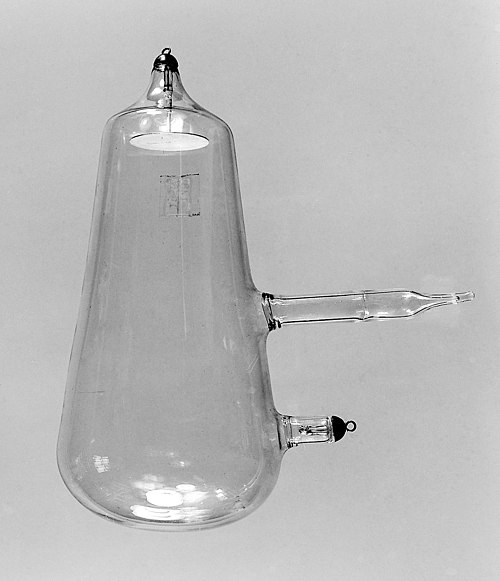
Example of a Crookes tube, a type of discharge tube that emitted X-rays

Wilhelm Röntgen
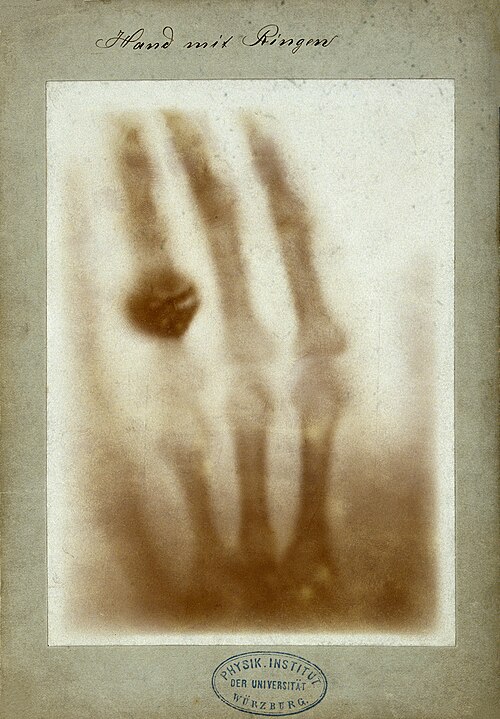
Hand mit Ringen (Hand with Rings): print of Wilhelm Röntgen's first "medical" X-ray, of his wife's hand, taken on 22 December 1895, and presented to Ludwig Zehnder of the Physik Institut, University of Freiburg, on January 1, 1896