Crosses in heraldry
Videos
A number of cross symbols were developed for the purpose of the emerging system of heraldry, which appeared in Western Europe in about 1200. This tradition is partly in the use of the Christian cross

9th-century Byzantine seal showing a patriarchal cross (seal of Niketas, commander of the Byzantine imperial fleet)

Seal of Bouchard de Marly (attested 1225), a cross, quarterly four alerions

Seal of Amadeus V, Count of Savoy (1249–1323), showing a knight on horseback displaying the Savoy cross on his shield, ailets (shoulder-pads) and caparison (horse covering)

A section of Segar's Roll, a 17th-century copy of a late 13th-century English roll of arms. Crosses are shown on the arms of: the legendary Prester John (attributed arms showing a full crucifix including the figure of Christ), the King of Jerusalem (the Jerusalem cross), the Emperor of Constantinople (the Palaiologos dynasty emblem with the Betas interpreted as crescents), the "King of Greece", and King Edward the Confessor of England (attributed arms showing a cross and five martlets).
Christian cross variants
Videos
The Christian cross, with or without a figure of Christ included, is the main religious symbol of Christianity. A cross with a figure of Christ affixed to it is termed a crucifix and the figure is oft
Crosses in heraldry
…Heraldic crosses are inherited in modern iconographic traditions and are used in numerous national flags. The Christian cross emblem (Latin cross or Greek cross) was used from the 5th century, deriving from a T-shape representing the gibbet (stauros, crux) of the crucifixion of Jesus in use from at least the…
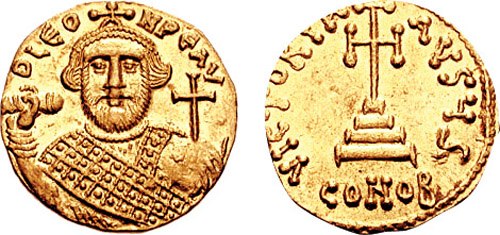
7th-century Byzantine solidus, showing Leontius holding a globus cruciger, with a stepped cross on the reverse side

Greek cross (Church of Saint Sava) and extended Greek cross (St Paul's Cathedral) in church floorplans

Cruz de los Angeles