The Crucifixion is the subject of three different paintings by the Italian Renaissance master Antonello da Messina; the first one was completed around 1454/1455, the second and the third in 1475. They
Antonello da Messina 026


Calvarieberg, Antonello da Messina, 1475, Koninlijk Museum voor Schone Kunsten Antwerpen, 4

Antonello da Messina 028
Early Netherlandish painting
Videos
Early Netherlandish painting is the body of work by artists active in the Burgundian and Habsburg Netherlands during the 15th- and 16th-century Northern Renaissance period, once known as the Flemish P
Crucifixion (Antonello da Messina)
…of Fine Arts Antwerp (Antwerp, Belgium) and in the National Gallery (London, England), respectively. An early work appearing to be influenced by the Flemish school, the Sibiu Crucifixion was formerly attributed to an unknown 14th century German painter. A symbolic view of Messina is depicted in the background…
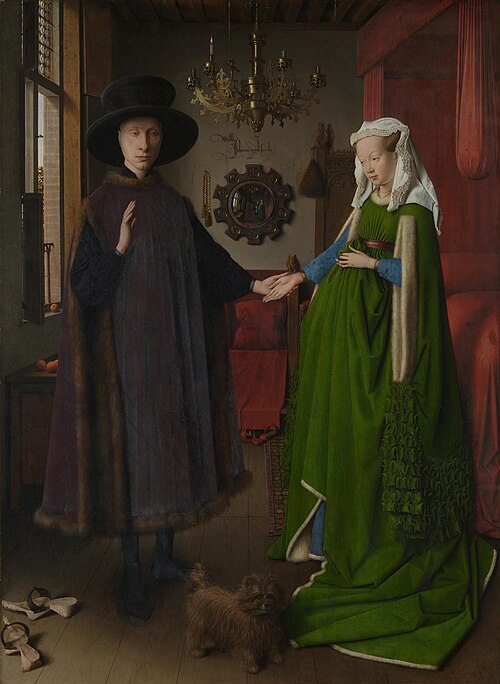
Jan van Eyck, The Arnolfini Portrait, 1434, National Gallery, London

Rogier van der Weyden, The Descent from the Cross, c. 1435, Museo del Prado, Madrid

The Ghent Altarpiece, completed in 1432 by Hubert and Jan van Eyck. This polyptych and the Turin-Milan Hours are generally seen as the first major works of the Early Netherlandish period.

Hieronymus Bosch, The Garden of Earthly Delights, c. 1490–1510. Museo del Prado, Madrid. Art historians are divided as to whether the central panel was intended as a moral warning or as a panorama of paradise lost.