The Crucifixion and Last Judgement diptych consists of two small painted panels attributed to the Early Netherlandish artist Jan van Eyck, with areas finished by unidentified followers or members of h


Death of Christ on the cross. Typically, a crucifixion victim's legs were broken to hasten death. According to the Gospel of John, when soldiers came to break Jesus' legs, they found him already dead. A soldier pierced his side with a lance; blood and water poured from the wound.

The taunting of the condemned. At the time there were many enemies of the Temple and Jesus was seen by the Jewish hierarchy merely as the charismatic successor to John the Baptist. Although he became enough of a legitimate threat to be executed, he was ultimately viewed by the elders as just another agitating pseudo-prophet.

Leaf from the Turin-Milan Hours, unknown artist, c. 1440–1450. This illustration is often attributed to Jan van Eyck or a member of his workshop.
Early Netherlandish painting
Videos
Early Netherlandish painting is the body of work by artists active in the Burgundian and Habsburg Netherlands during the 15th- and 16th-century Northern Renaissance period, once known as the Flemish P
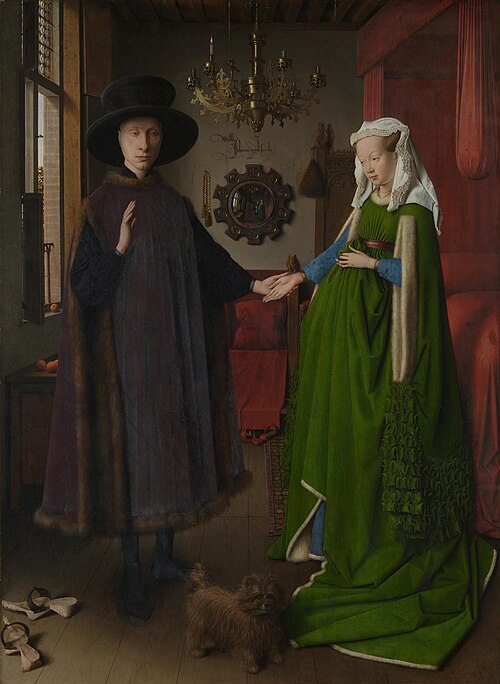
Jan van Eyck, The Arnolfini Portrait, 1434, National Gallery, London

Rogier van der Weyden, The Descent from the Cross, c. 1435, Museo del Prado, Madrid

The Ghent Altarpiece, completed in 1432 by Hubert and Jan van Eyck. This polyptych and the Turin-Milan Hours are generally seen as the first major works of the Early Netherlandish period.

Hieronymus Bosch, The Garden of Earthly Delights, c. 1490–1510. Museo del Prado, Madrid. Art historians are divided as to whether the central panel was intended as a moral warning or as a panorama of paradise lost.