Cryptanalysis
Videos
Cryptanalysis refers to the process of analyzing information systems in order to understand hidden aspects of the systems. Cryptanalysis is used to breach cryptographic security systems and gain acces

Reconstruction of the appearance of cyclometer, a device used to break the encryption of an early version of the Enigma machine. Based on sketches in Marian Rejewski's memoirs.

The decrypted Zimmermann Telegram.
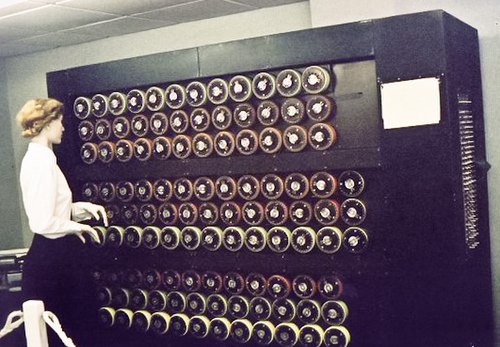
The Bombe replicated the action of several Enigma machines wired together. Each of the rapidly rotating drums, pictured above in a Bletchley Park museum mockup, simulated the action of an Enigma rotor.
Enigma machine
Videos
The Enigma machine is a cipher device developed and used in the early- to mid-20th century to protect commercial, diplomatic, and military communication. It was employed extensively by Nazi Germany du
Cryptanalysis
…1805–81) succeeded in breaking this cipher. During World War I, inventors in several countries developed rotor cipher machines such as Arthur Scherbius' Enigma, in an attempt to minimise the repetition that had been exploited to break the Vigenère system. In World War I, the breaking of the Zimmermann Telegram…

Military Model Enigma I, in use from 1930

A memorial in Bydgoszcz, Poland, to Marian Rejewski, the mathematician who, in 1932, first broke Enigma and, in July 1939, helped educate the French and British about Polish methods of Enigma decryption

Enigma in use, 1943
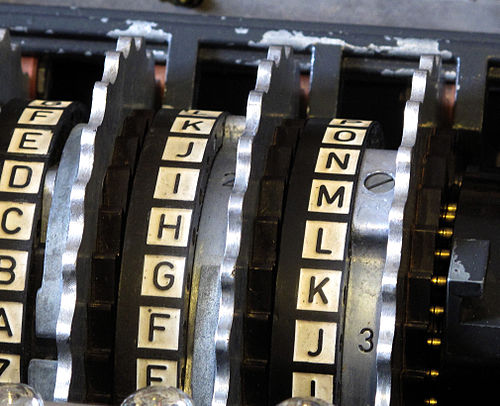
Enigma rotor assembly. In the Enigma I, three movable rotors are sandwiched between two fixed wheels: the entry wheel, on the right, and the reflector on the left.