General Miguel Primo de Rivera's dictatorship over Spain began with a coup on 13 September 1923 and ended with his resignation on 28 January 1930. It took place during the wider reign of King Alfonso XIII. In establishing his dictatorship, Primo de Rivera ousted the liberal government led by Prime Minister Manuel García Prieto and initially gained the support of King Alfonso XIII and the army. During the Military Directory (1923–1925), the dictatorship created the official party of the regime, the Unión Patriótica (UP). It also censored the Spanish press and worked to eliminate separatism in Catalonia. Under Primo de Rivera's dictatorship, Spain won the Rif War, where Spanish forces fought Riffian tribes in Morocco.


Announcement of the new government of Primo de Rivera in Madrid, 1923

Poster for the 1929 Iberian-American Exhibition in Seville.

Clara Campoamor – who refused a seat on the National Assembly – in 1930
Prime Minister of Spain
Videos
The prime minister of Spain, officially president of the Government, is the head of government of Spain. The prime minister chairs the Council of Ministers and nominates its ministers; in these sense, the prime minister establishes the Government policies and coordinates the actions of the Cabinet members. As chief executive, the prime minister also advises the monarch on the exercise of their royal prerogatives.

Adolfo Suárez delivers his inaugural address to the Congress of Deputies at the Palacio de las Cortes, Madrid on March 30, 1979.

The Palace of Moncloa or Moncloa Palace is the official residence and workplace of the prime minister.
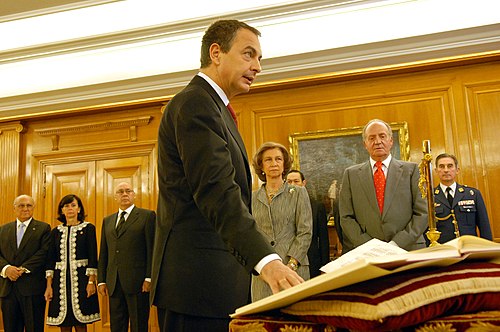
José Luis Rodríguez Zapatero taking the affirmation of office in his second inauguration in 2008. While placing, as mandated, the right hand in the Constitution, being a non-religious, he waived the Bible and the Crucifix.