Dilberjin Tepe
Videos
Dilberjin Tepe, also Dilberjin or Delbarjin, is the modern name for the remains of an ancient town in modern Afghanistan. The town was perhaps founded in the time of the Achaemenid Empire. Under the K

A coin of Kidara on the model of Varahran, of the type found in Dilberjin. Circa CE 350–365, Balkh mint.

Remains of the Dioscuri mural at the entrance (left side of the mural).

Dilberjin fresco, 5th-6th century.

Dilberjin fresco fragment.
Bactrian language
Videos
Bactrian was an Eastern Iranian language formerly spoken in the Central Asian region of Bactria and used as the official language of the Kushan and the Hephthalite empires.
Dilberjin Tepe
…seems slightly younger than the inscription of Surkh Kotal. Outside the city walls there were still substantial buildings. Finds include inscriptions in Bactrian, most of them too destroyed to provide any historical information. There were fragments of sculpture and many coins. The paintings of Dilberjin Tepe…
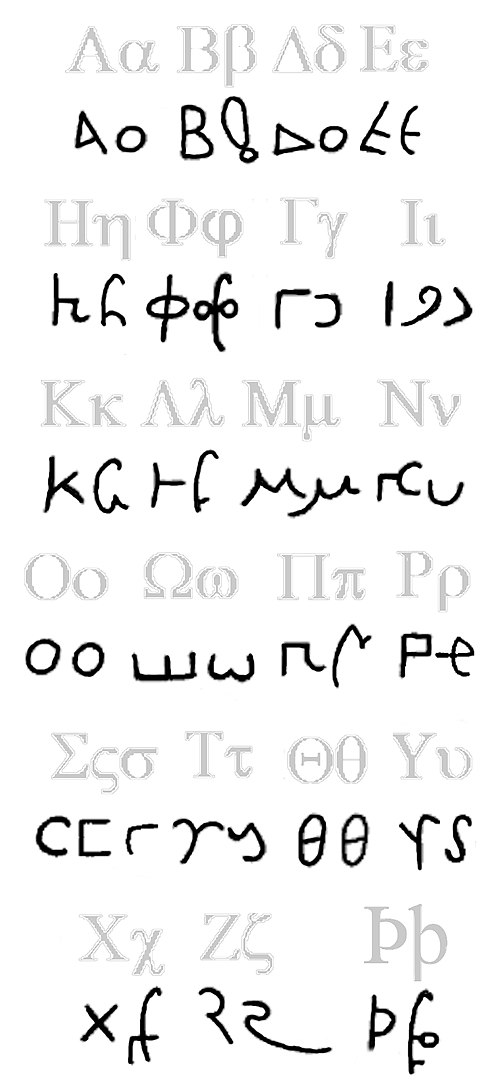
The Bactrian alphabet (block and cursive letters, here in black). The Bactrian script was directly adapted from the Greek script (here in grey), with the addition of the letter sho (ϸ).

The Rabatak inscription is an inscription written on a rock in the Bactrian language and the Greek script, which was found in 1993 at the site of Rabatak, near Surkh Kotal in Afghanistan. The inscription relates to the rule of the Kushan emperor Kanishka, and gives remarkable clues on the genealogy of the Kushan dynasty.

The word αλχοννο (alkhonno) in cursive Bactrian script, on a coin of the Alchon Huns ruler Khingila, 5th century AD.

The Surkh Kotal inscription (SK4) is the first known substantial document written in Bactrian, an Iranian language. It uses the Greek script. It was written at the time of the Kushan ruler Huvishka, 2nd century CE. Kabul Museum.