Disease
Videos
A disease is a particular abnormal condition that adversely affects the structure or function of all or part of an organism and is not immediately due to any external injury. Diseases are often known

"The Sick Girl", by Michael Ancher, 1882, National Gallery of Denmark

This rash only affects one part of the body, so it is a localized disease.

Regular physical activity, such as riding a bicycle or walking, reduces the risk of lifestyle diseases.

Obesity was a status symbol in Renaissance culture: "The Tuscan General Alessandro del Borro", attributed to Andrea Sacchi, 1645. It is now generally regarded as a disease.
Signs and symptoms
Videos
Signs and symptoms are diagnostic indications of an illness, injury, or condition. While signs are objective and externally observable, symptoms are a person's reported subjective experiences.
Disease
…of an organism and is not immediately due to any external injury. Diseases are often known to be medical conditions that are associated with specific signs and symptoms. A disease may be caused by external factors such as pathogens or by internal dysfunctions. For example, internal dysfunctions of the immune system can…
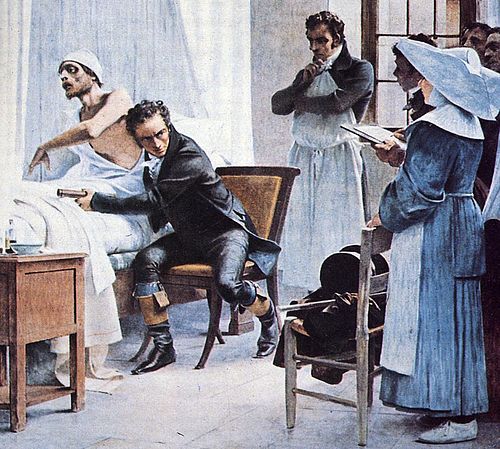
Painting of René Laennec in 1816 using an early method of auscultation on a man with tuberculosis