Dominion of India
Videos
The Dominion of India, officially the Union of India, was an independent dominion in the British Commonwealth of Nations existing between 15 August 1947 and 26 January 1950. Until its independence, In
Administrative divisions of India, 1949


Clement Attlee left with King George VI on the grounds of Buckingham Palace after Labour Party's victory in the general elections, 26 July 1945.

Lord Mountbatten swearing in Jawaharlal Nehru as the first prime minister of independent India on 15 August 1947

Huseyn Shaheed Suhrawardy, left, prime minister of Bengal (1946–1947) and later prime minister of Pakistan, and Mahatma Gandhi during their 73-hour fast in Calcutta to stop religious violence in the days after India's Independence Day
Partition of India
Videos
The partition of India in 1947 was the division of British India into two independent dominion states, the Union of India and Dominion of Pakistan. The Union of India is today the Republic of India, a
Dominion of India
…Accordingly, the use of one of the British monarch's regnal titles, "Emperor of India", was abandoned. The Dominion of India came into existence upon the partition of India, a process under and legal act of the Government and Crown of the United Kingdom. Its creation was preceded, however, by a pioneering and influential…
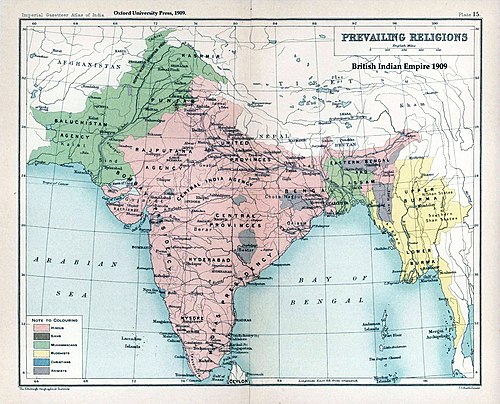
The prevailing religions of the British Indian Empire based on the Census of India, 1901

1909 percentage of Hindus.

1909 percentage of Muslims.

1909 percentage of Sikhs, Buddhists, and Jains.