Du Mu
Videos
Du Mu was a Chinese calligrapher, poet, and politician who lived during the late Tang dynasty. His courtesy name was Muzhi, and art name Fanchuan. He is best known for his lyrical and romantic quatrai
Du Mu by Shangguan Zhou (上官周, b. 1665)

Du Fu
Videos
Du Fu was a Chinese poet and government official of the Tang dynasty. Together with his older contemporary and friend Li Bai, he is one of the principal poets associated with Tang poetry. Nearly 1,500
Du Mu
…mentioned together with that of another renowned Late Tang poet, Li Shangyin, as the "Little Li-Du" (小李杜), in contrast to the "Great Li-Du": Li Bai and Du Fu. Among his influences were Du Fu, Li Bai, Han Yu and Liu Zongyuan. Du Mu was born in the Tang capital Chang'an (modern Xi'an) into an elite family, the…
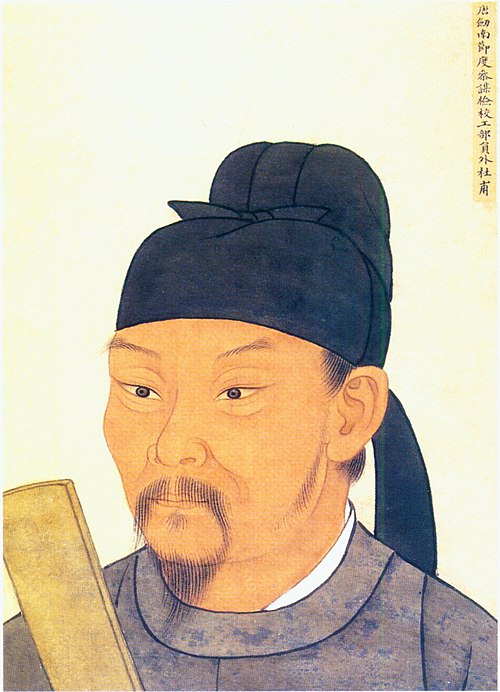
Posthumous portrait

Du Fu's China

The statue in his Thatched Cottage, Chengdu, China

A calligraphic copy of Du Fu's poem "Zui Ge Xing" by Dong Qichang