Eastern esotericism
Videos
Eastern esotericism is a term used by some scholars that loosely encompasses religious beliefs and practices of the Eastern world said to be "esoteric", secret, or occult. Its demarcation as a field,
Yab-Yum of Samantabhadra ("All Good," the Primordial Buddha) and his female aspect of consort, Samantabhadrī (17th century). The erotic union symbolizes, respectively, the non-duality of Compassion (or Method) and Wisdom; or also of Form and Emptiness.


Enki, guardian of Me, god of groundwater and wisdom, with fish flowing from his shoulders and an eagle descending in front of him. Seal of Adda (ca. 2300 BCE, Akkadian Empire)

Mesopotamian seal from the first millennium B.C., showing a sage dressed as a fish and a worshiper in front of him, as well as celestial representations such as the winged solar disk symbol, a crescent moon, and a cluster of stars

Symbolic scene of Ashurbanipal in ritual clothing, in front of a sacred tree, accompanied by winged jinn (865-860 BCE)
Vajrayana
Videos
Vajrayāna, otherwise known as Mantrayāna, Guhyamantrayāna, Tantrayāna, Indo-Tibetan Buddhism, Tantric Buddhism, and Esoteric Buddhism, is a vehicle of the Mahāyāna Buddhist tradition that emphasizes e
Eastern esotericism
…guhya ("secret"). The mere equation of these terms, however, presents problems. In general, the terms "tantric Buddhism," "esoteric Buddhism," and "Vajrayana"- vajra meaning "diamond" or "ray", regarding the unchanging and indestructible state of awakening - are also used interchangeably. In China, Chinese…
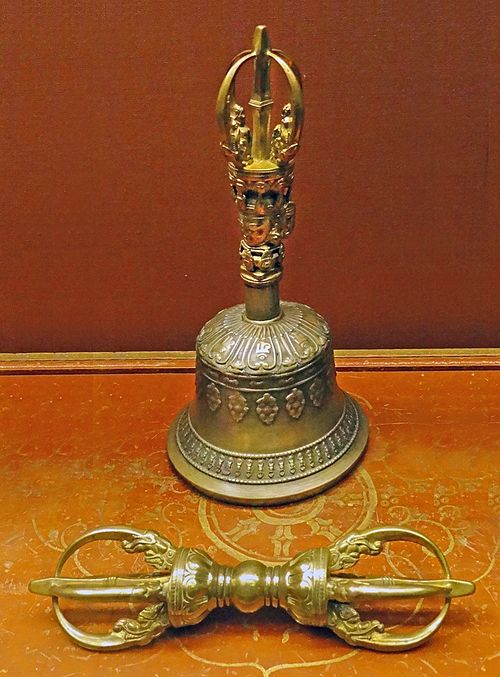
A vajra and bell (ghanta), which are classic ritual symbols of Vajrayāna Buddhism

Mahasiddhas, Palpung monastery. Note the figure of the great adept Putalipa at center, seated in a cave and gazing at an image of the meditational deity Samvara and the figure at the bottom left holding a skull-staff (khaṭvāṅga) and a flaying knife (kartika).
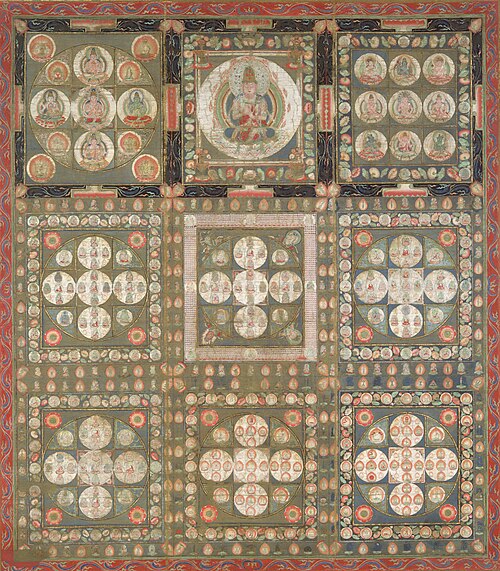
Vajra Realm Mandala, based on the tantric Vajrasekhara Sutra, and symbolizing the final realization of Vairocana Buddha in Shingon

Naked tantrikas dancing and eating from skull cups (kapalas), closeup of a Chakrasamvara mandala