Eastern hunter-gatherer
Videos
In archaeogenetics, eastern hunter-gatherers, sometimes called east European hunter-gatherers or eastern European hunter-gatherers, are a distinct ancestral component which represents the Mesolithic h

Eastern Hunter Gatherer

Reconstruction of burial No. 132 of the Oleneostrovsky burial ground (Yuzhni Oleny island, Lake Onega). Exhibit of the National Museum of the Republic of Karelia.
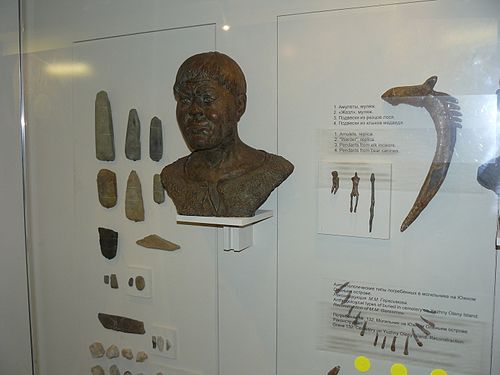
Artifacts and reconstruction of Eastern Hunter-Gatherers from Yuzhny Oleny island by Gerasimov.
Western Steppe Herders
Videos
In archaeogenetics, the term Western Steppe Herders, or Western Steppe Pastoralists, is the name given to a distinct ancestral component first identified in individuals from the Chalcolithic steppe ar
Eastern hunter-gatherer
…Caucasus hunter-gatherers (CHGs), with the resulting population, which was almost half-EHG and half-CHG, forming the genetic cluster that is known as Western Steppe Herder (WSH). WSH populations that were closely related to the people of the Yamnaya culture embarked upon a massive migration which lead to the spread of…

Migration of Yamnaya-related people, according to Anthony (2007), (2017); Narasimhan et al. (2019); Nordqvist & Heyd (2020): 3000 BC: Initial eastward migration initiating the Afanasievo culture, possibly Proto-Tocharian. 2900 BC: North-westward migrations carrying Corded Ware culture, transforming into Bell Beaker; according to Anthony, westward migration west of Carpatians into Hungary as Yamnaya, transforming into Bell Beaker, possibly ancestral to

Scheme of Indo-European migrations from c. 3000 to 800 BC

The eastern part of the Corded Ware culture contributed to the Sintashta culture (c. 2100–1800 BC), where the Indo-Iranian languages and culture emerged.