Edicts of Ashoka
Videos
The Edicts of Ashoka are a collection of more than thirty inscriptions on the Pillars of Ashoka, as well as boulders and cave walls, attributed to Emperor Ashoka of the Mauryan Empire who ruled most o
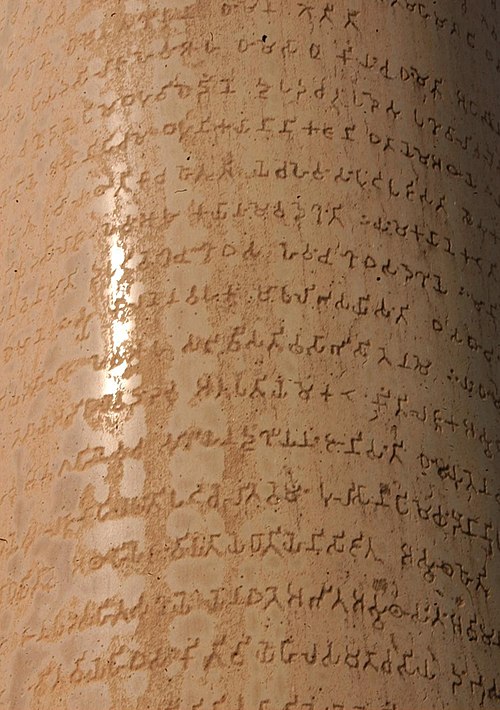
A Major Pillar Edict of Ashoka, in Lauriya Araraj, Bihar, India

Brahmi script consonants, and their evolution down to modern Devanagari, according to James Prinsep, as published in the Journal of the Asiatic Society of Bengal, in March 1838. All the letters are correctly deciphered, except for two missing on the right: 𑀰(ś) and 𑀱(ṣ).
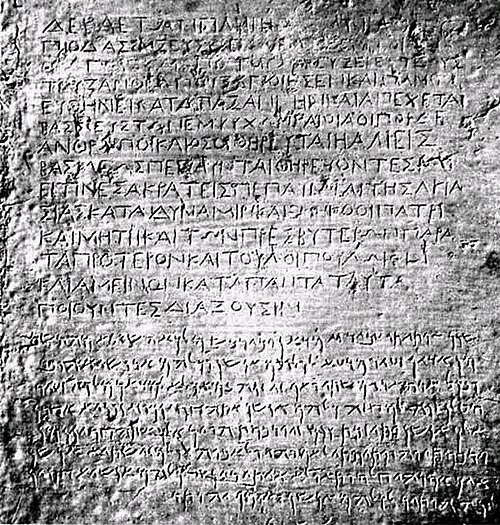
The first known inscription by Ashoka, the Kandahar Bilingual Rock Inscription, in Greek and in Aramaic, written in the 10th year of his reign (260 BCE).

Minor Rock Edict from Maski.
Maurya Empire
Videos
The Maurya Empire was a geographically extensive Iron Age historical power in South Asia with its power base in Magadha. Founded by Chandragupta Maurya around c. 320 BCE, it existed in loose-knit fash
Edicts of Ashoka
…are a collection of more than thirty inscriptions on the Pillars of Ashoka, as well as boulders and cave walls, attributed to Emperor Ashoka of the Mauryan Empire who ruled most of the Indian subcontinent from 268 BCE to 232 BCE. These inscriptions were dispersed throughout the areas of modern-day India, Bangladesh…

A Pre-Mauryan to early-Mauryan terracotta statuette from Buxar, Bihar, ca. 4th century BCE (Bihar Museum, Arch. 6650).

Alexander the Great's empire in 326 BCE. The routes taken to South Asia and the return from South Asia to Babylon by land and sea are shown.

Alexander's eastern Satrapies, with territories ceded by the Seleucid Empire in 303 BCE.

Pataliputra, capital of the Mauryas. Ruins of pillared hall at Kumrahar site.