Electromotive force
Videos
In electromagnetism and electronics, electromotive force or electromotance, denoted E, is an energy transfer to an electric circuit per unit of electric charge, measured in volts. Devices called elect

A typical reaction path requires the initial reactants to cross an energy barrier, enter an intermediate state and finally emerge in a lower energy configuration. If charge separation is involved, this energy difference can result in an emf. See Bergmann et al. and Transition state.
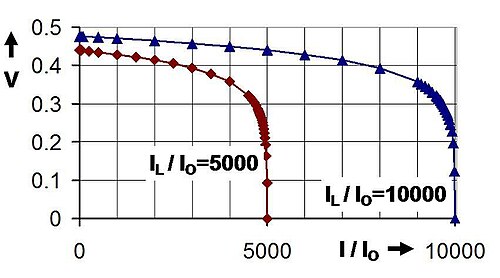
Solar cell output voltage for two light-induced currents IL expressed as a ratio to the reverse saturation current I0 and using a fixed ideality factor m of 2. Their emf is the voltage at their y-axis intercept.
Faraday's law of induction
Videos
In electromagnetism, Faraday's law of induction describes how a changing magnetic field can induce an electric current in a circuit. This phenomenon, known as electromagnetic induction, is the fundame
Electromotive force
…to charge separation. If a load is attached, this voltage can drive a current. The general principle governing the emf in such electrical machines is Faraday's law of induction. In 1801, Alessandro Volta introduced the term "force motrice électrique" to describe the active agent of a battery (which he had invented around 1798…

Faraday's disk, the first electric generator, a type of homopolar generator