Epistle to the Galatians
Videos
The Epistle to the Galatians is the ninth book of the New Testament of the Christian Bible and the fourth of the Pauline epistles in traditional arrangement. It is a letter from Paul the Apostle to a
The end of Ephesians, continuing on to Galatians 1:1–8 on Papyrus 46 (fol. 158 recto; c. AD 200)


Valentin de Boulogne's depiction of "Saint Paul Writing His Epistles", 16th century (Blaffer Foundation Collection, Houston, Texas). Lightfoot notes with respect to verse 6:11 that at this point "the apostle takes the pen from his amanuensis, and the concluding paragraph is written with his own hand".

Ann Arbor, University of Michigan P.Mich.inv. 6238 fol. 142r 2 Corinthians 11,33 12,9

Rembrandt Harmensz. van Rijn 163
Galatia
Videos
Galatia, also called Gallograikia, was an ancient area in the highlands of central Anatolia, roughly corresponding to the provinces of Ankara and Eskişehir in modern Turkey. Galatia was named after th
Epistle to the Galatians
…and the fourth of the Pauline epistles in traditional arrangement. It is a letter from Paul the Apostle to a number of Early Christian communities in Galatia. Scholars have suggested that this is either the Roman province of Galatia in southern Anatolia, or a large region defined by Galatians, an ethnic group…

Areas of Galatian settlement in the 3rd and early 2nd centuries BC
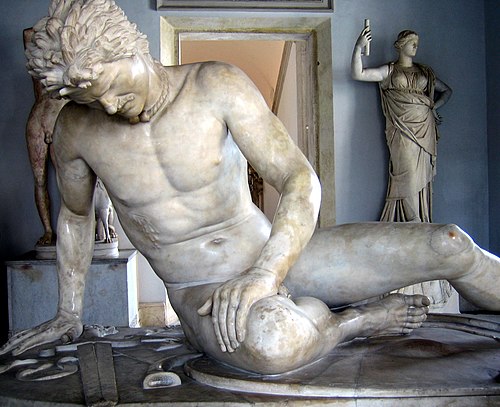
The Dying Gaul, Capitoline Museums, Rome

A Galatian's head as depicted on a gold Thracian objet d'art, 3rd century BC. Istanbul Archaeological Museum.

Galatian bronze horse bit, 3rd century BC, Hidirsihlar tumulus, Bolu. Istanbul Archaeological Museum.