Charles I, King of England, Scotland and Ireland, was publicly executed on 30 January 1649 outside the Banqueting House on Whitehall, London. The execution was the culmination of political and militar

A contemporary German print of the execution of Charles I outside the Banqueting House. Based on the earliest European depiction of the execution.

A Lively Representation of the Manner how his late Majesty was Beheaded upon the Scaffold, a Restoration print of Charles making his speech upon the scaffold.

The title page of The Confession of Richard Brandon, a 1649 pamphlet claiming to reveal Richard Brandon as Charles I's executioner.

Anonymous Dutch painting of the execution of Charles I, 1649. While depictions of the execution were suppressed in England, European depictions like this were produced, emphasising the shock of the crowd with fainting women and bloodied streets.
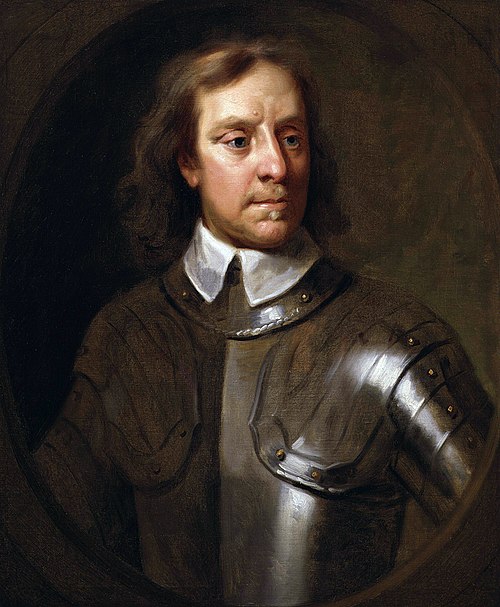
Oliver Cromwell
Videos
Oliver Cromwell was an English statesman, farmer and soldier, widely regarded as one of the most important figures in British history. He came to prominence during the Wars of the Three Kingdoms, init
Execution of Charles I of England
…and his assistant were never revealed to the public, with crude face masks and wigs hiding them at the execution, and they were probably known only to Oliver Cromwell and a few of his colleagues. The clean cut on Charles's head and the fact the executioner held up Charles's head after the execution suggests the…

Cromwell's House in Ely

Portrait of Cromwell's wife Elizabeth Bourchier

Cromwell at the Battle of Naseby by Charles Landseer, 1851