External ballistics
Videos
External ballistics or exterior ballistics is the part of ballistics that deals with the behavior of a projectile in flight. It deals with projectiles under the influence of a gravitational field; it

Typical trajectory graph for a M4 carbine and M16A2 rifle using identical M855 cartridges with identical projectiles. Though both trajectories have an identical 25 m near zero, the difference in muzzle velocity of the projectiles gradually causes a significant difference in trajectory and far zero.[clarification needed] The 0 inch axis represents the line of sight or horizontal sighting plane.
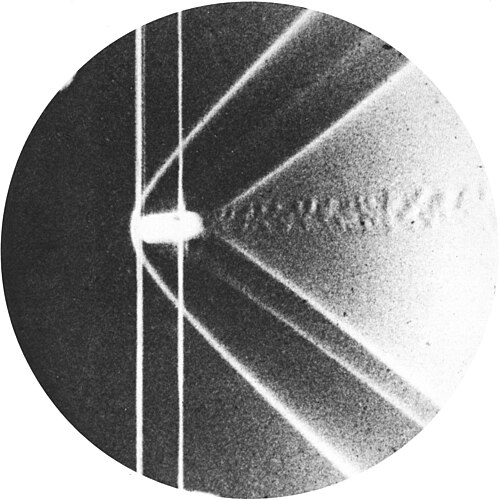
Schlieren photo/Shadowgraph of the detached shock or bow shockwave around a bullet in supersonic flight, published by Ernst Mach in 1888

Left German 7.9 mm s.S. (FMJ) and right S.m.E. ammunition beside their boat-tailed projectiles with cannelures
Ballistic coefficient
Videos
In ballistics, the ballistic coefficient of a body is a measure of its ability to overcome air resistance in flight. It is inversely proportional to the negative acceleration: a high number indicates
External ballistics
…aerodynamic properties to properly describe flight trajectories is by empirical measurement. Use of ballistics tables or ballistics software based on the Mayevski/Siacci method and G1 drag model, introduced in 1881, are the most common method used to work with external ballistics. Projectiles are described by a ballistic…

Wind drift calculations for rifle bullets of differing G1 BCs fired with a muzzle velocity of 2,950 ft/s (900 m/s) in a 10 mph (4.5 m/s; 16 km/h) crosswind

Energy calculations for 9.1 grams (140 gr) rifle bullets of differing G1 BCs fired with a muzzle velocity of 2,950 feet per second (900 m/s)