Fūjin
Videos
Fūjin or Fūten, sometimes also known as Ryobu, is the Japanese god of the wind and one of the eldest Shinto and Buddhist gods. He is portrayed as a terrifying wizardly demon, resembling a red-haired,
Sculpture of Fūjin from Sanjūsangen-dō temple in Kyoto. Kamakura period, 13th century


Fūjin depicted on a folding screen by Tawaraya Sōtatsu (1570–1640)

Statue at Taiyū-in in Nikkō

Iconographical evolution of the Wind God. Left: Greek wind God (Greco-Buddhist art of Gandhara), Hadda, 2nd century. Middle: Wind God from Kizil, Tarim Basin, 7th century. Right: Japanese Wind God Fujin, 17th century.
Raijin
Videos
Raijin, also known as Kaminari-sama, Raiden-sama, Narukami, Raikō, and Kamowakeikazuchi-no-kami is a thunder god in Japanese mythology and the Shinto and Buddhist religion. He is typically depicted wi
Fūjin
…a large, inflated bag of winds (風袋; Kazebuko/Fūtai) on his shoulders. In Japanese art, the deity is often depicted together with his twin-brother, Raijin, the god of lightning & thunder, and together, along with their brother, Susanoo-no-Mikoto, they are the Shinto gods (Kami) of storms. According to…

Sculpture of Raijin from Sanjūsangen-dō temple in Kyoto. Kamakura period, 13th century
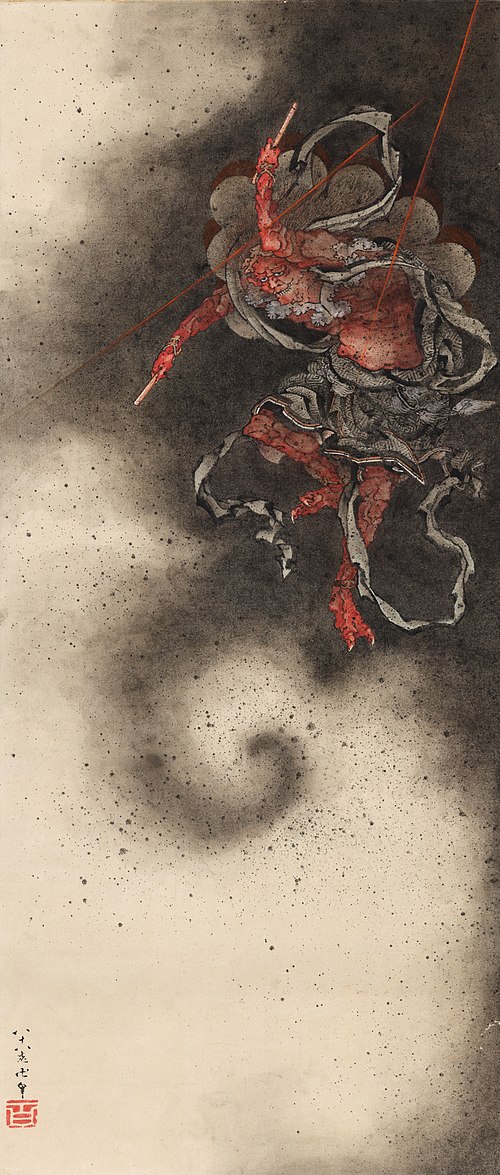
Raijin by Katsushika Hokusai Hanging scroll painting, 1834–1849

Detail of Raijin from Wind God and Thunder God, a folding screen by Ogata Kōrin. Edo period, circa 1700. Based on an original by Tawaraya Sōtatsu.

Netsuke depicting Raijin, by Kaigyokusai Masatsugu (1813–1892)