The fall of the Western Roman Empire, also called the fall of the Roman Empire or the fall of Rome, was the loss of central political control in the Western Roman Empire, a process in which the Empire

An ivory diptych, thought to depict Stilicho (right) with his wife Serena and son Eucherius, ca. 395 (Monza Cathedral)

A contemporary depiction of Honorius on a consular diptych issued by Anicius Petronius Probus to celebrate Probus's consulship in 406, now in the Aosta museum

Chi-rho pendant of Empress Maria, daughter of Stilicho, and wife of Honorius, now in the Louvre, Paris. The pendant reads, around a central cross (clockwise): HONORI MARIA SERHNA VIVATIS STELICHO. The letters form a Christogram.

Inscription honouring Honorius, as florentissimo invictissimoque, the most excellent and invincible, 417–418, Forum Romanum
Byzantine Empire
Videos
The Byzantine Empire, also known as the Eastern Roman Empire, was the continuation of the Roman Empire centred on Constantinople during late antiquity and the Middle Ages. Having survived the fall of
Fall of the Western Roman Empire
…legitimacy lasted for centuries longer and its cultural influence remains, the Western Empire never had the strength to rise again. The Eastern Roman, or Byzantine, Empire, survived and remained for centuries an effective power of the Eastern Mediterranean, although it lessened in strength. While the loss of…

Constantine I, also known as Constantine the Great, was Roman emperor from AD 306 to 337 and the first Roman emperor to convert to Christianity. He founded the city of Constantinople (now Istanbul) and made it the capital of the Empire, which it remained for over a millennium.

The Theodosian Walls of Constantinople, very important during the 717–718 siege
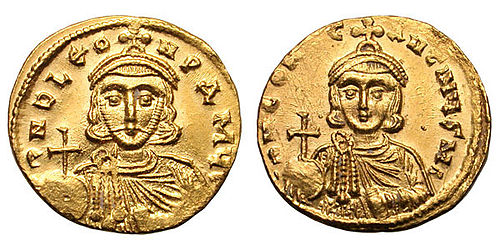
Gold solidus of Leo III (left) and his son and heir, Constantine V (right)

The seizure of Edessa (1031) by the Byzantines under George Maniakes and the counterattack by the Seljuk Turks