Fermat's Last Theorem
Videos
In number theory, Fermat's Last Theorem states that there are no positive integers a, b, c, n with n > 2 such that a n + b n = c n. The cases n = 1 and n = 2 have been known since antiquity to have in
The 1670 edition of Diophantus's Arithmetica includes Fermat's commentary, referred to as his "Last Theorem" (Observatio Domini Petri de Fermat), posthumously published by his son.
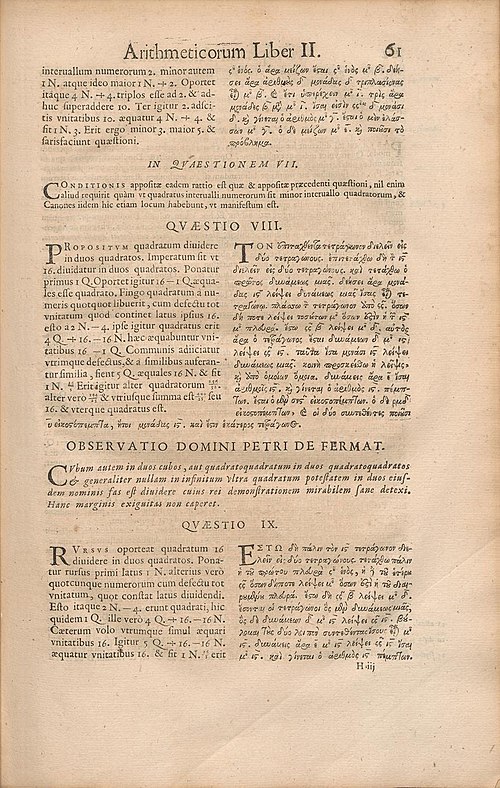

Problem II.8 in the 1621 edition of the Arithmetica of Diophantus. On the right is the margin that was too small to contain Fermat's alleged proof of his "last theorem".

British mathematician Andrew Wiles

Czech postage stamp commemorating Wiles' proof
Pierre de Fermat
Videos
Pierre de Fermat was a French magistrate, polymath, and above all, a mathematician who is given credit for early developments that led to infinitesimal calculus, including his technique of adequality.
Fermat's Last Theorem
…c n . The cases n = 1 and n = 2 have been known since antiquity to have infinitely many solutions. The proposition was first stated as a theorem by Pierre de Fermat around 1637 in the margin of a copy of Arithmetica. Fermat added that he had a proof that was too large to fit in the margin. Although other statements…

Pierre de Fermat, 17th-century painting by unknown artist

Pierre de Fermat, 17th century painting by Rolland Lefebvre
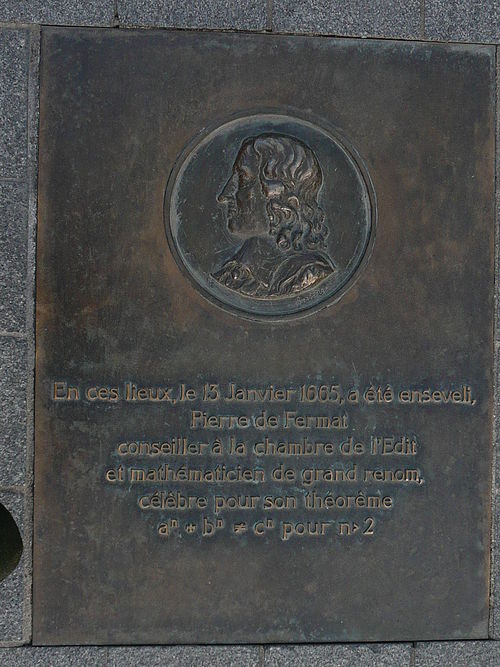
Place of burial of Pierre de Fermat in Place Jean Jaurés, Castres. Translation of the plaque: in this place was buried on January 13, 1665, Pierre de Fermat, councillor at the Chambre de l'Édit (a court established by the Edict of Nantes) and mathematician of great renown, celebrated for his theorem, an + bn ≠ cn for n > 2.