Flame
Videos
A flame is the visible, gaseous part of a fire. It is caused by a highly exothermic chemical reaction made in a thin zone. When flames are hot enough to have ionized gaseous components of sufficient d

Flames of charcoal

Different flame types of a Bunsen burner depend on oxygen supply. On the left a rich fuel with no premixed oxygen produces a yellow sooty diffusion flame; on the right a lean fully oxygen premixed flame produces no soot and the flame color is produced by molecular radicals, especially CH and C2 band emission.
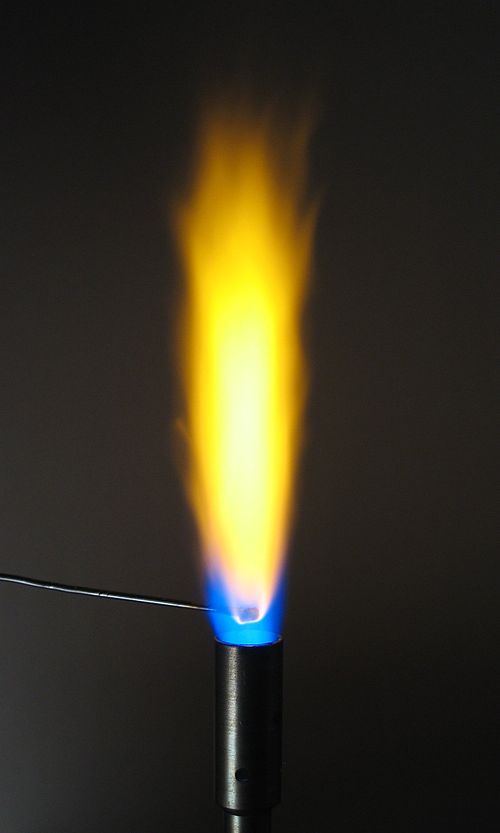
A flame test for sodium. The yellow color in this gas flame does not arise from the black-body emission of soot particles (as the flame is clearly a blue premixed complete combustion flame) but instead comes from the spectral line emission of sodium atoms, specifically the very intense sodium D lines.

In zero-G, convection does not carry the hot combustion products away from the fuel source, resulting in a spherical flame front.
Pyrotechnic colorant
Videos
A pyrotechnic colorant is a chemical compound which causes a flame to burn with a particular colour. These are used to create the colours in pyrotechnic compositions like fireworks and coloured fires.
Flame
…analytical chemistry, this effect is used in flame tests (or flame emission spectroscopy) to determine presence of some metal ions. In pyrotechnics, the pyrotechnic colorants are used to produce brightly colored fireworks. When looking at a flame's temperature there are many factors which can change or apply. An important…

Copper compounds glow green or blue-green in a flame.